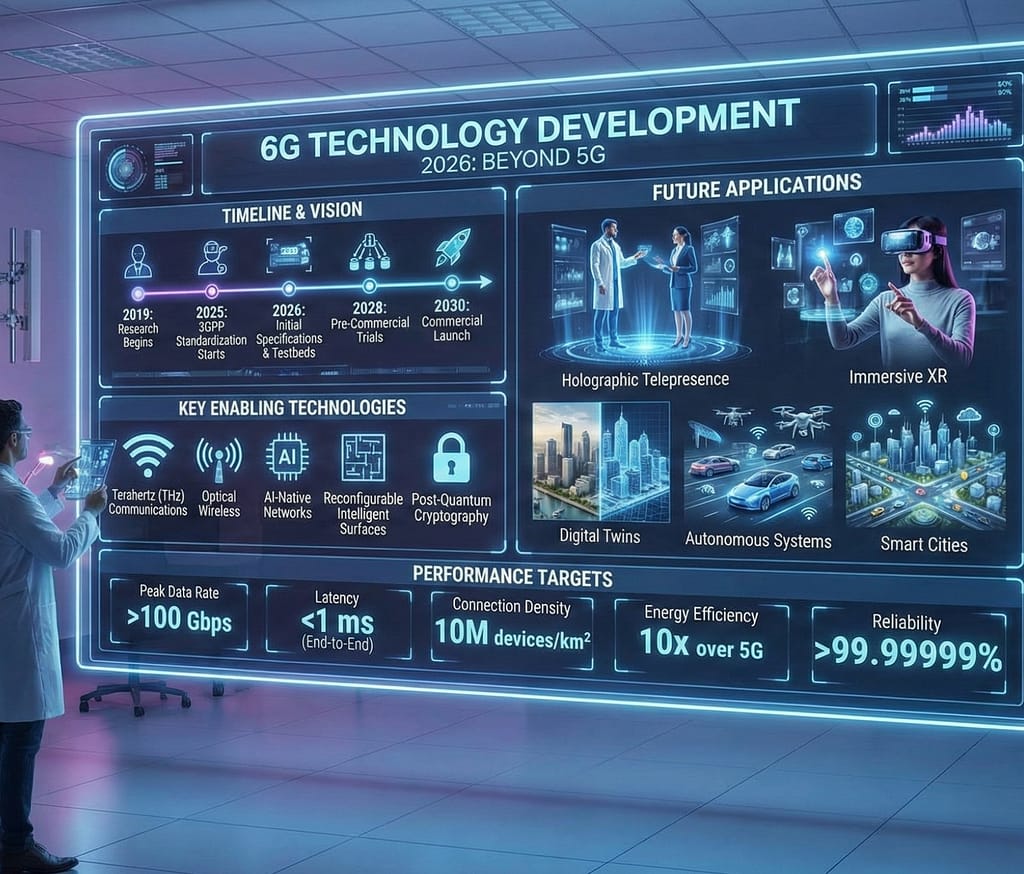

The world is still expanding its 5G infrastructure, but research into the next generation of wireless communication has already begun. 6G Technology Development 2026 is becoming a major discussion point among telecom companies, governments, and technology researchers. While 5G improved speed and reduced latency, 6G aims to transform the entire digital ecosystem with intelligent, ultra-fast, and deeply connected networks.
Although commercial 6G networks are expected to launch around 2030, 2026 marks a critical research phase where standards, testing, and early prototypes are actively being developed. This article explores what 6G technology is, how it may differ from 5G, and what users and industries can expect in the future.
The Evolution of Wireless Networks
To understand 6G, it helps to look at how mobile networks have evolved:
- 1G introduced analog voice communication.
- 2G enabled digital voice and SMS messaging.
- 3G brought mobile internet access.
- 4G delivered high-speed streaming and app ecosystems.
- 5G improved latency and enabled IoT connectivity.
Each generation expanded digital capabilities. 6G is expected to go beyond faster speeds and focus on intelligent, automated, and immersive communication.
What Is 6G Technology?
6G stands for sixth-generation wireless communication technology. It represents the next stage in mobile networking after 5G.
Unlike 5G, which focuses on enhanced broadband and device connectivity, 6G is expected to combine:
- Artificial intelligence integration
- Terahertz frequency spectrum
- Ultra-high-speed data transmission
- Near-zero latency
- Smart infrastructure automation
6G networks are expected to be AI-driven from the ground up, making them self-optimizing and more energy-efficient.
Expected Speed and Performance Improvements
One of the most discussed aspects of 6G Technology Development 2026 is performance.
Experts predict that 6G could deliver speeds far beyond 5G capabilities. This would allow:
- Instant large-file downloads
- Real-time holographic communication
- Ultra-smooth cloud gaming
- Advanced remote operations
Latency, which measures communication delay, may become almost negligible. This improvement is critical for applications like remote surgery, autonomous driving, and industrial robotics.
Artificial Intelligence at the Core of 6G
Artificial intelligence will play a central role in 6G networks.
Unlike earlier generations, 6G will likely be AI-native. This means AI will be embedded into the network architecture itself.
AI may handle:
- Traffic management
- Network optimization
- Cybersecurity detection
- Signal routing
- Energy consumption control
This could reduce human intervention and make networks more reliable and adaptive.
Terahertz Spectrum and Advanced Frequencies
6G research is exploring the use of terahertz frequency bands. These frequencies are much higher than those used in 5G.
Higher frequency bands can transmit massive amounts of data quickly. However, they also require advanced infrastructure because signals may not travel as far as lower frequencies.
To support this, new antenna designs and advanced signal-processing technologies are being developed.
Immersive Communication and Holographic Technology
One of the most futuristic expectations from 6G is holographic communication.
6G networks could enable:
- Real-time 3D video calls
- Fully immersive virtual reality meetings
- Advanced augmented reality experiences
This would significantly impact industries such as education, entertainment, gaming, and remote work.
The metaverse concept may also become more practical with 6G support.
Impact on Smart Cities and IoT Expansion
The Internet of Things (IoT) is growing rapidly with 5G, but 6G may take it to the next level.
6G could support billions of connected devices simultaneously. Smart cities may benefit from:
- Intelligent traffic systems
- Real-time environmental monitoring
- Smart energy grids
- Automated public safety systems
Instant communication between devices will allow smoother urban operations.
6G in Healthcare
Healthcare is one of the sectors that could benefit greatly from 6G technology.
Possible applications include:
- Remote robotic surgeries
- Real-time patient monitoring
- AI-powered diagnostics
- Ultra-clear telemedicine communication
Near-zero latency and high reliability are essential in medical procedures, and 6G could provide that level of performance.
Industrial Automation and Robotics
Manufacturing industries rely on automation and robotics. 6G networks may enhance:
- Smart factories
- Predictive maintenance
- Real-time machine coordination
- Advanced robotics control
Faster communication between machines will improve productivity and reduce downtime.
Cybersecurity in 6G Networks
As connectivity increases, security becomes more critical.
6G development includes strong focus on:
- Advanced encryption
- AI-driven threat detection
- Quantum-resistant security measures
- Secure device authentication
Security is expected to be integrated into the network’s core design.
Environmental and Energy Considerations
Future networks must also be energy-efficient.
6G researchers are exploring ways to:
- Reduce energy consumption
- Optimize power usage with AI
- Build sustainable infrastructure
Energy efficiency will be crucial as billions of devices become connected.
Global Research and Investment
Countries worldwide are investing in 6G research.
Technology companies, telecom providers, and universities are collaborating on:
- Terahertz communication research
- AI-network integration
- Advanced semiconductor development
Competition among global tech leaders is shaping early 6G standards.
Challenges Facing 6G Development
Despite its promise, 6G faces several challenges:
- High infrastructure costs
- Signal range limitations
- Technical complexity
- Regulatory approvals
- Security risks
Large-scale deployment will require international cooperation and long-term investment.
When Will 6G Be Available?
Although 6G research is active in 2026, commercial rollout is expected around 2030 or later.
Before that, several steps must occur:
- Global standards finalization
- Infrastructure testing
- Device compatibility development
- Regulatory clearance
Until then, 5G will continue expanding globally.
6G vs 5G: Key Differences
While 5G focuses on faster speeds and IoT, 6G aims to introduce:
- AI-driven intelligent networks
- Terahertz communication
- Holographic experiences
- Deep digital ecosystem integration
6G is expected to redefine not only connectivity speed but the overall digital experience.
How 6G May Change Everyday Life
For everyday users, 6G may offer:
- Instant downloads
- Seamless streaming
- Advanced smart home automation
- Immersive virtual learning
- Real-time AI assistance
Although the technology may seem futuristic, similar advancements were once expected only from 5G.
Conclusion
6G Technology Development 2026 marks the beginning of the next revolution in wireless communication. While still in research and testing stages, its potential impact is enormous. From AI-driven networks and terahertz frequencies to immersive holographic communication, 6G aims to transform how the world connects.
Although commercial deployment may take several years, current investments and global research efforts indicate that 6G will shape the next decade of technological innovation.
For readers of Digital Technologia, understanding 6G today means staying prepared for the connected world of tomorrow.