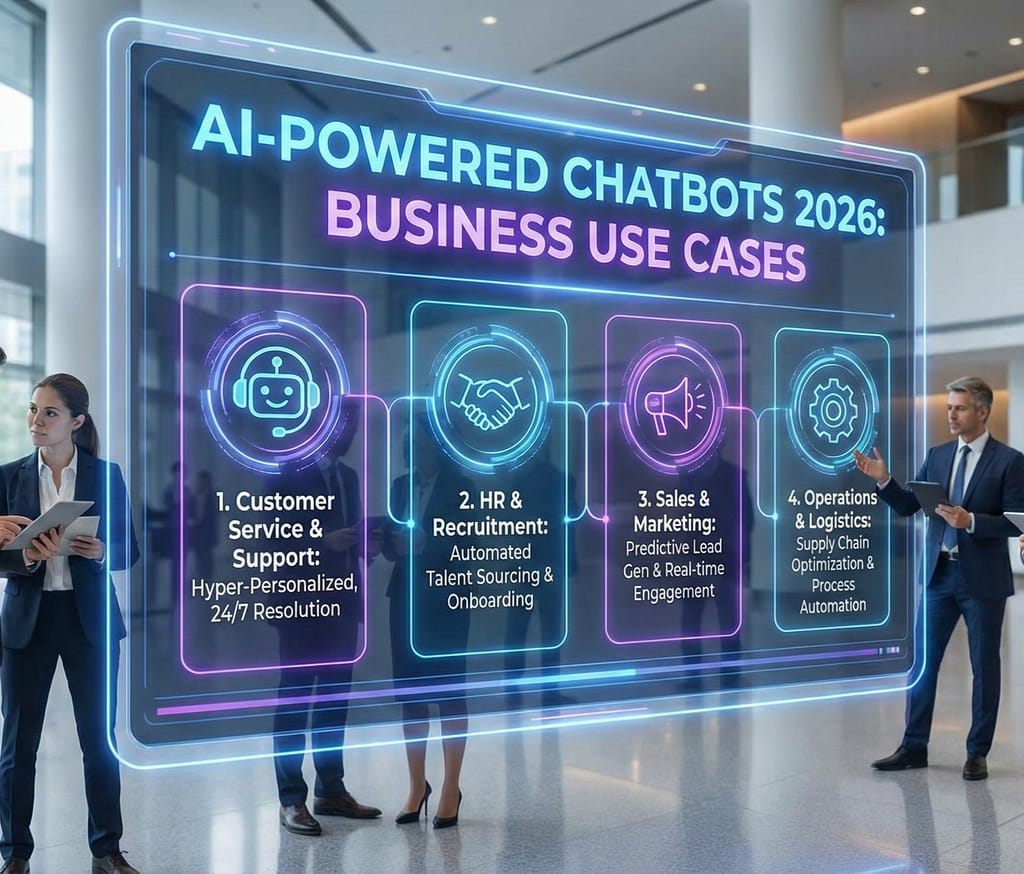

Artificial Intelligence has transformed digital communication, and in 2026, AI-powered chatbots have become essential business tools rather than optional features. Companies across industries now use intelligent chat systems to automate customer service, generate leads, reduce operational costs, and improve user engagement.
AI-Powered Chatbots in 2026 are significantly more advanced than earlier rule-based bots. Modern chatbots use machine learning, natural language processing (NLP), contextual memory, and predictive analytics to deliver human-like conversations.
This comprehensive article explores how AI-powered chatbots work, major business use cases, industry adoption trends, benefits, challenges, and future growth.
What Are AI-Powered Chatbots?
AI-powered chatbots are intelligent software applications that simulate human conversation using artificial intelligence and natural language processing.
Unlike basic scripted bots, modern AI chatbots:
- Understand user intent
- Learn from conversations
- Adapt responses dynamically
- Handle multi-step conversations
- Integrate with business systems
Companies use AI chatbot systems powered by advanced models such as those developed by OpenAI and Google to improve interaction accuracy.
How AI Chatbots Work in 2026
AI-powered chatbots combine several technologies:
| Technology Component | Function |
|---|---|
| Natural Language Processing (NLP) | Understands user queries |
| Machine Learning | Improves responses over time |
| Large Language Models | Generates human-like text |
| API Integration | Connects to CRM, ERP, databases |
| Context Memory | Maintains conversation history |
These technologies enable chatbots to move beyond scripted answers.
Why Businesses Are Adopting AI Chatbots
The rise of digital communication has increased demand for instant responses. Businesses need 24/7 customer support without high operational costs.
Key Reasons for Adoption
- Cost reduction
- Faster response times
- Automation of repetitive tasks
- Improved customer satisfaction
- Lead generation and conversion
AI chatbots are now viewed as digital employees.
Major Business Use Cases of AI-Powered Chatbots in 2026
1. Customer Support Automation
One of the most common applications is customer service.
Chatbots handle:
- Frequently asked questions
- Order tracking
- Refund requests
- Technical troubleshooting
Benefits
| Benefit | Business Impact |
|---|---|
| 24/7 Support | Increased customer satisfaction |
| Reduced Staffing Costs | Lower operational expenses |
| Faster Query Resolution | Improved brand reputation |
AI chatbots significantly reduce call center workload.
2. E-Commerce Assistance
Online stores use chatbots for:
- Product recommendations
- Order assistance
- Cart recovery
- Upselling and cross-selling
Chatbots integrate with payment gateways and CRM systems.
Example Use Case
A chatbot suggests related products based on user browsing history.
This increases average order value.
3. Lead Generation and Sales Qualification
Businesses use AI chatbots to:
- Capture user information
- Qualify potential leads
- Schedule appointments
- Route prospects to sales teams
Lead Qualification Workflow
| Stage | Chatbot Role |
|---|---|
| Visitor Interaction | Collects user query |
| Qualification | Asks targeted questions |
| Lead Scoring | Determines purchase intent |
| Handoff | Transfers to sales representative |
Chatbots improve sales pipeline efficiency.
4. Banking and Financial Services
Banks deploy AI chatbots for:
- Account balance inquiries
- Loan information
- Transaction tracking
- Fraud alerts
Security is enhanced through biometric verification and multi-factor authentication.
Chatbots reduce dependency on physical branches.
5. Healthcare Assistance
Healthcare providers use AI chatbots for:
- Appointment booking
- Symptom assessment
- Medication reminders
- Patient follow-up
Healthcare Chatbot Benefits
| Benefit | Outcome |
|---|---|
| Reduced Waiting Time | Better patient experience |
| Automated Scheduling | Operational efficiency |
| Pre-Diagnosis Support | Faster triage process |
AI chatbots assist but do not replace medical professionals.
6. Human Resources Automation
HR departments use chatbots for:
- Interview scheduling
- Candidate screening
- Policy explanation
- Employee onboarding
This reduces administrative workload.
7. Education and E-Learning
Educational platforms deploy chatbots for:
- Course recommendations
- Student query resolution
- Assignment reminders
- Learning guidance
AI tutors personalize learning paths.
8. IT Helpdesk and Technical Support
Companies use AI chatbots internally for:
- Password resets
- Software troubleshooting
- IT ticket creation
- System status updates
This improves employee productivity.
9. Travel and Hospitality Industry
Hotels and airlines use chatbots for:
- Booking assistance
- Travel updates
- Check-in reminders
- Customer queries
AI enhances customer experience.
10. Social Media and Marketing Automation
Businesses use chatbots on messaging platforms for:
- Automated replies
- Campaign promotions
- Feedback collection
- Community management
Marketing automation increases engagement.
AI Chatbot Revenue Impact in 2026
AI-powered chatbots contribute to revenue through:
- Conversion rate optimization
- Reduced support costs
- Increased engagement
- Personalized marketing
Estimated Business Benefits
| Metric | Impact Range |
|---|---|
| Cost Reduction | 20–40% |
| Customer Response Time | Reduced by 60% |
| Lead Conversion Rate | Increased by 15–25% |
Chatbots create measurable ROI.
Challenges of AI-Powered Chatbots
Despite advantages, challenges include:
- Data privacy concerns
- Over-automation risks
- Misinterpretation of complex queries
- Bias in training data
Businesses must balance automation with human support.
AI Chatbots vs Human Agents
| Factor | AI Chatbot | Human Agent |
|---|---|---|
| Availability | 24/7 | Limited Hours |
| Cost | Lower | Higher |
| Emotional Intelligence | Moderate | High |
| Scalability | High | Limited |
Best approach: Hybrid model (AI + human collaboration).
Future of AI-Powered Chatbots Beyond 2026
Future developments may include:
- Emotion detection through voice analysis
- Multilingual real-time translation
- AI-powered voice assistants
- Deeper CRM integration
- Autonomous decision-making systems
Chatbots will become more conversational and context-aware.
Final Conclusion
AI-Powered Chatbots in 2026 are transforming how businesses communicate with customers, manage internal processes, and increase revenue efficiency. From customer service automation and sales qualification to healthcare and finance applications, chatbots are becoming essential digital infrastructure.
Businesses that adopt intelligent chatbot systems gain operational efficiency, improved customer satisfaction, and measurable financial benefits.
As AI technology advances, chatbots will continue evolving from simple assistants into fully integrated digital business partners.
For Digital Technologia, this topic positions your AI & Tools category as professional, business-focused, and future-oriented.