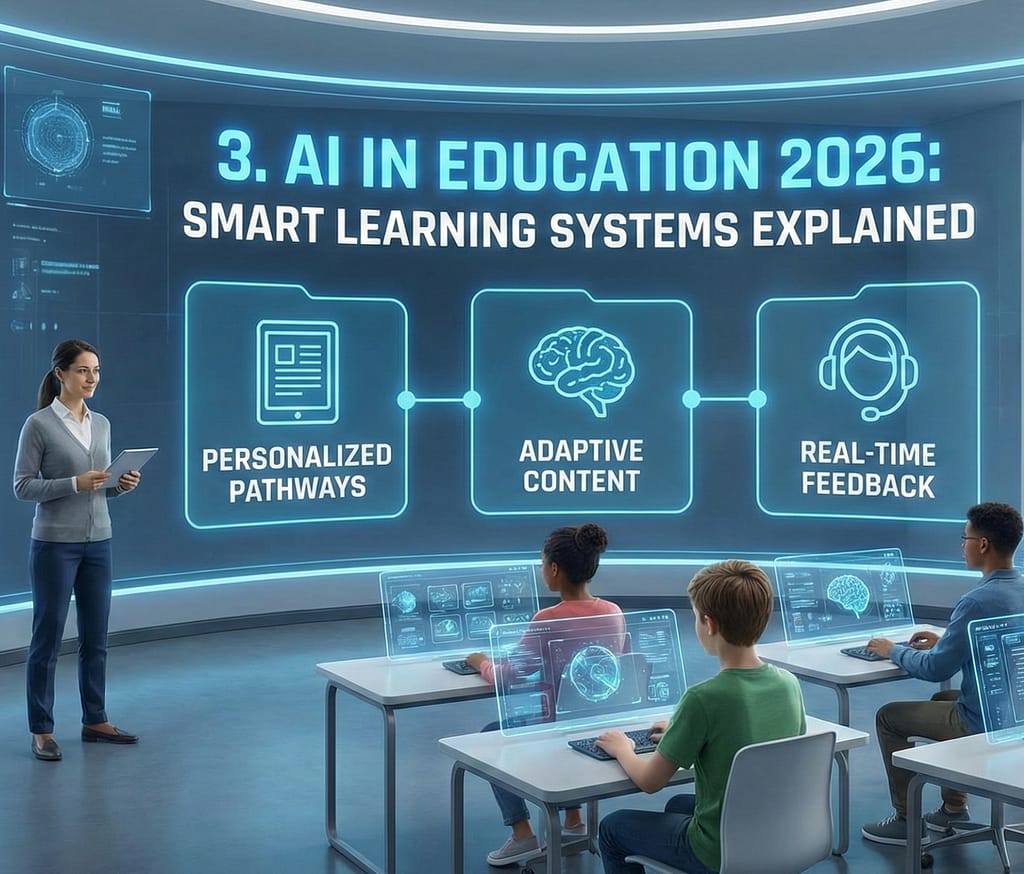

Education is undergoing one of the most significant transformations in modern history. In 2026, Artificial Intelligence is no longer a supporting tool in classrooms — it is becoming a foundational technology that reshapes how students learn, teachers teach, and institutions operate.
AI in Education 2026 represents a shift toward personalized learning, automated assessments, intelligent tutoring systems, predictive student analytics, and global digital accessibility. Smart learning systems powered by artificial intelligence are improving engagement, efficiency, and learning outcomes across schools, universities, and online platforms.
This in-depth guide explains how AI is transforming education through adaptive learning, automation, data analytics, virtual classrooms, skill development systems, and future-ready educational infrastructure.
What Is AI in Education?
AI in education refers to the integration of machine learning, natural language processing, predictive analytics, and automation tools into academic systems.
Smart learning systems analyze:
- Student performance data
- Learning patterns
- Engagement levels
- Behavioral indicators
- Skill progression
Based on this data, AI platforms provide personalized recommendations and real-time feedback.
Major technology companies like Google and Microsoft provide cloud-based AI education solutions for institutions worldwide.
The Shift from Traditional Learning to Smart Learning Systems
Traditional education systems rely on standardized teaching methods where all students follow the same pace and curriculum structure.
AI-powered smart learning systems introduce:
- Adaptive curriculum paths
- Personalized assessments
- Automated feedback
- Real-time progress tracking
This transition improves educational efficiency.
AI-Powered Personalized Learning
Personalized learning is one of the most impactful developments in AI in Education 2026.
AI systems adjust:
- Difficulty levels
- Lesson pacing
- Content recommendations
- Practice exercises
based on individual student performance.
Personalized Learning Benefits
| Feature | Educational Impact |
|---|---|
| Adaptive Content | Matches student ability |
| Performance Tracking | Identifies weaknesses |
| Customized Exercises | Improves retention |
| Data-Driven Feedback | Faster improvement |
Students no longer learn at a uniform pace.
Intelligent Tutoring Systems
AI tutoring systems simulate one-on-one guidance.
They:
- Answer student questions
- Explain concepts step-by-step
- Provide practice quizzes
- Offer instant correction
These systems are available 24/7, reducing dependency on physical tutoring.
Automated Grading and Assessment
AI reduces teacher workload through automated evaluation systems.
AI can grade:
- Multiple-choice exams
- Essays (with NLP models)
- Coding assignments
- Mathematical problem-solving
Automated Assessment Advantages
| Benefit | Result |
|---|---|
| Faster Grading | Immediate feedback |
| Reduced Bias | Objective scoring |
| Time Efficiency | Teacher workload reduction |
| Performance Analytics | Detailed student insights |
Teachers can focus more on mentoring rather than repetitive grading tasks.
AI in Online Learning Platforms
Online education platforms use AI to:
- Recommend courses
- Track learning progress
- Suggest skill upgrades
- Provide interactive quizzes
AI improves completion rates by identifying disengaged learners early.
Predictive Analytics in Education
Predictive AI models analyze student data to:
- Identify dropout risk
- Forecast exam performance
- Suggest intervention strategies
Early intervention increases success rates.
Predictive Analytics Impact
| Application | Benefit |
|---|---|
| Dropout Prediction | Early academic support |
| Skill Gap Analysis | Targeted improvement |
| Attendance Monitoring | Behavioral insight |
Educational institutions use AI dashboards to monitor trends.
AI in Virtual Classrooms
Virtual classrooms in 2026 use AI for:
- Automated attendance tracking
- Real-time language translation
- Speech-to-text transcription
- Engagement monitoring
AI enables global accessibility.
AI for Language Learning
AI language systems offer:
- Real-time pronunciation feedback
- Conversational simulations
- Grammar correction
- Vocabulary tracking
Students receive immediate improvement suggestions.
AI in STEM Education
AI tools assist in:
- Coding education
- Simulation-based science experiments
- Virtual lab environments
- Robotics training
Students gain hands-on experience through virtual simulations.
AI and Accessibility in Education
AI enhances accessibility for students with disabilities.
Examples include:
- Speech recognition tools
- Text-to-speech systems
- Visual recognition support
- Personalized assistance features
Inclusive education becomes more achievable.
AI in Higher Education and Research
Universities use AI for:
- Academic research analysis
- Data modeling
- Plagiarism detection
- Admission screening
AI accelerates academic research processes.
Economic Impact of AI in Education 2026
AI adoption improves:
- Institutional efficiency
- Reduced administrative costs
- Increased student success rates
- Better resource allocation
Institutional Benefits Overview
| Sector | AI Contribution |
|---|---|
| K-12 Schools | Personalized learning |
| Universities | Research optimization |
| Online Platforms | Student retention |
| Corporate Training | Skill gap identification |
AI reduces inefficiencies across education systems.
AI in Corporate Training and Skill Development
Companies use AI learning platforms for:
- Employee upskilling
- Skill gap analysis
- Training recommendations
- Performance monitoring
Continuous learning becomes automated.
Ethical Concerns and Challenges
Despite benefits, challenges include:
- Data privacy risks
- Algorithm bias
- Over-dependence on automation
- Digital divide issues
- High implementation cost
Responsible AI governance is essential.
AI vs Traditional Teaching
| Factor | Traditional System | AI Smart System |
|---|---|---|
| Personalization | Limited | High |
| Feedback Speed | Slow | Instant |
| Scalability | Moderate | Very High |
| Data Analytics | Manual | Automated |
AI complements teachers rather than replacing them.
AI in Education: India’s Perspective
India is rapidly adopting AI in education due to:
- Growing online learning platforms
- Government digital initiatives
- Youth population growth
- Remote learning needs
AI-powered education helps bridge rural and urban gaps.
Future of AI in Education Beyond 2026
Future developments may include:
- Emotion-aware learning systems
- Virtual reality classrooms
- Fully adaptive AI curriculum engines
- AI-driven career path mapping
Education will become more skill-oriented and data-driven.
Long-Term Impact on Society
AI in education contributes to:
- Higher literacy rates
- Better workforce preparation
- Reduced dropout rates
- Increased global accessibility
Smart learning systems create future-ready societies.
Final Conclusion
AI in Education 2026 is redefining how knowledge is delivered and consumed. From personalized learning paths and automated grading systems to predictive analytics and virtual classrooms, artificial intelligence is enhancing academic efficiency and accessibility.
While ethical and regulatory challenges remain, AI-driven education systems provide scalable, data-driven, and inclusive solutions for modern learning environments.
The future of education lies in collaboration between teachers and intelligent systems, creating smarter, more adaptive, and globally accessible learning ecosystems.
For Digital Technologia, this topic strengthens your AI & Tools section with forward-looking, research-level content.