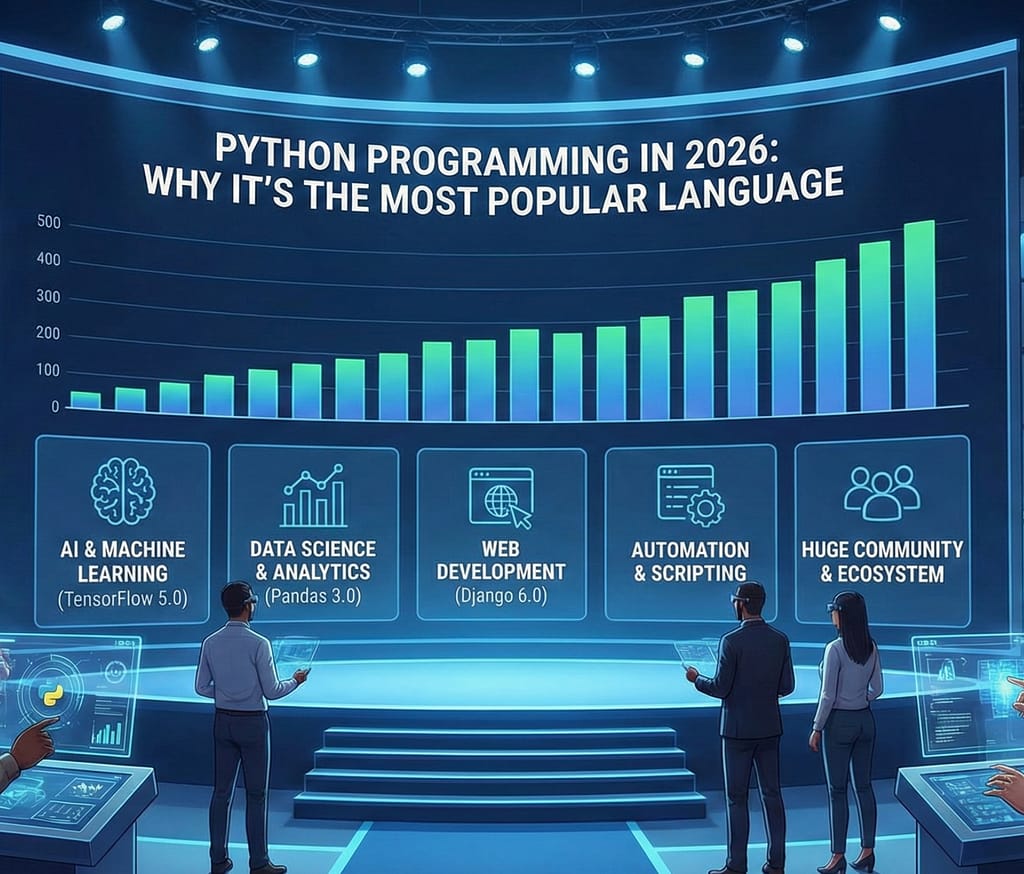

In 2026, Python continues to dominate the programming world. From artificial intelligence and data science to web development and automation, Python has become the foundation of modern software development.
Whether you are a beginner learning to code or a professional developer building complex systems, Python remains one of the most in-demand and widely used programming languages globally.
But why is Python still the most popular programming language in 2026?
This article explores Python’s growth, real-world applications, role in AI and data science, automation capabilities, web development frameworks, career opportunities, and future outlook.
What Is Python Programming?
Python is a high-level, interpreted programming language known for its simplicity, readability, and versatility.
It was created by Guido van Rossum in 1991, with a focus on writing clear and maintainable code.
Key characteristics of Python:
- Easy-to-read syntax
- Cross-platform compatibility
- Large standard library
- Strong community support
- Open-source development
Python allows developers to write powerful applications with fewer lines of code compared to many other languages.
Why Python Is the Most Popular Language in 2026
Python’s popularity in 2026 is driven by several major factors:
1. Beginner-Friendly Syntax
Python uses simple English-like commands. This makes it ideal for beginners.
Example:
Instead of complex syntax, Python code is clean and readable.
This simplicity attracts students and first-time programmers.
2. Strong Role in Artificial Intelligence
Python is the backbone of modern AI systems.
Major AI frameworks built using Python include:
- TensorFlow
- PyTorch
- Keras
These frameworks are used for:
- Machine learning
- Deep learning
- Natural language processing
- Computer vision
- Chatbot development
AI growth is one of the biggest reasons Python dominates in 2026.
Python in Data Science
Data is one of the most valuable assets in the digital world. Python plays a critical role in analyzing and processing data.
Popular Python libraries for data science include:
- NumPy
- Pandas
- Matplotlib
Why Data Scientists Prefer Python
| Feature | Benefit |
|---|---|
| Easy Data Manipulation | Faster analysis |
| Visualization Tools | Clear insights |
| Machine Learning Integration | Predictive modeling |
| Large Community | Continuous updates |
Companies rely on Python for business intelligence and analytics.
Python for Automation
Automation is another major reason Python remains popular.
Businesses use Python to automate:
- File handling
- Email sending
- Web scraping
- Data entry tasks
- System monitoring
Python scripts reduce repetitive manual work and increase efficiency.
Example automation uses:
- Automated report generation
- Scheduled data backups
- Social media posting scripts
Python is widely used in DevOps environments for infrastructure automation.
Python in Web Development
Python is also a powerful web development language.
Popular Python web frameworks include:
- Django
- Flask
Why Developers Choose Python for Web Development
| Advantage | Explanation |
|---|---|
| Rapid Development | Faster project launch |
| Clean Code Structure | Easy maintenance |
| Built-in Security | Safe applications |
| Scalability | Suitable for startups & enterprises |
Many startups use Django to build scalable web platforms quickly.
Python in Cybersecurity
Cybersecurity professionals use Python for:
- Ethical hacking
- Penetration testing
- Security scripting
- Malware analysis
Python tools simplify vulnerability scanning and network monitoring.
Python in Cloud and DevOps
Python integrates with cloud platforms such as:
- Amazon Web Services
- Microsoft Azure
- Google Cloud
It is widely used for:
- Infrastructure scripting
- Deployment automation
- Cloud management
DevOps engineers rely on Python for automation workflows.
Python vs Other Programming Languages in 2026
| Feature | Python | Java | C++ |
|---|---|---|---|
| Ease of Learning | Very Easy | Moderate | Hard |
| AI & ML Support | Excellent | Moderate | Limited |
| Performance | Moderate | High | Very High |
| Community Support | Massive | Large | Large |
| Automation | Excellent | Limited | Limited |
Python may not always be the fastest language, but its flexibility makes it ideal for most applications.
Career Opportunities in Python (2026)
Python developers are in high demand.
Common job roles:
- Python Developer
- Data Scientist
- Machine Learning Engineer
- AI Engineer
- Automation Engineer
- Backend Developer
Why Python Skills Are Valuable
| Reason | Impact |
|---|---|
| AI Growth | Increased demand |
| Data-Driven Companies | More hiring |
| Startup Ecosystem | Rapid development needs |
| Remote Work | Global opportunities |
Python is one of the highest-paying programming skills in 2026.
Why Companies Prefer Python
Companies prefer Python because:
- It reduces development time
- It has strong third-party libraries
- It supports rapid prototyping
- It integrates well with AI systems
Startups choose Python for fast product launches.
Enterprises use Python for analytics and backend services.
Challenges of Python
Despite its advantages, Python has some limitations:
- Slower execution speed compared to C++
- Higher memory usage
- Not ideal for mobile app development
However, for most applications, these limitations are manageable.
Future of Python Beyond 2026
Python’s future looks strong due to:
- AI expansion
- Data science growth
- Automation demand
- Cloud computing integration
Python continues evolving with performance improvements and better tooling.
As AI systems become more advanced, Python’s ecosystem is expected to expand even further.
Why Beginners Should Learn Python in 2026
If you are starting programming, Python is one of the best choices because:
- Easy syntax
- Large community support
- Massive learning resources
- Career opportunities
- Versatile applications
Python provides a solid foundation before moving to advanced languages.
Final Conclusion
Python Programming in 2026 remains the most popular and versatile programming language worldwide. Its simplicity, powerful AI and data science libraries, automation capabilities, and strong web development frameworks make it a dominant force in modern technology.
From startups to large enterprises, Python continues to power artificial intelligence systems, business analytics, cloud infrastructure, and automation workflows.
For beginners and professionals alike, Python remains a smart choice for career growth and long-term relevance in the tech industry.