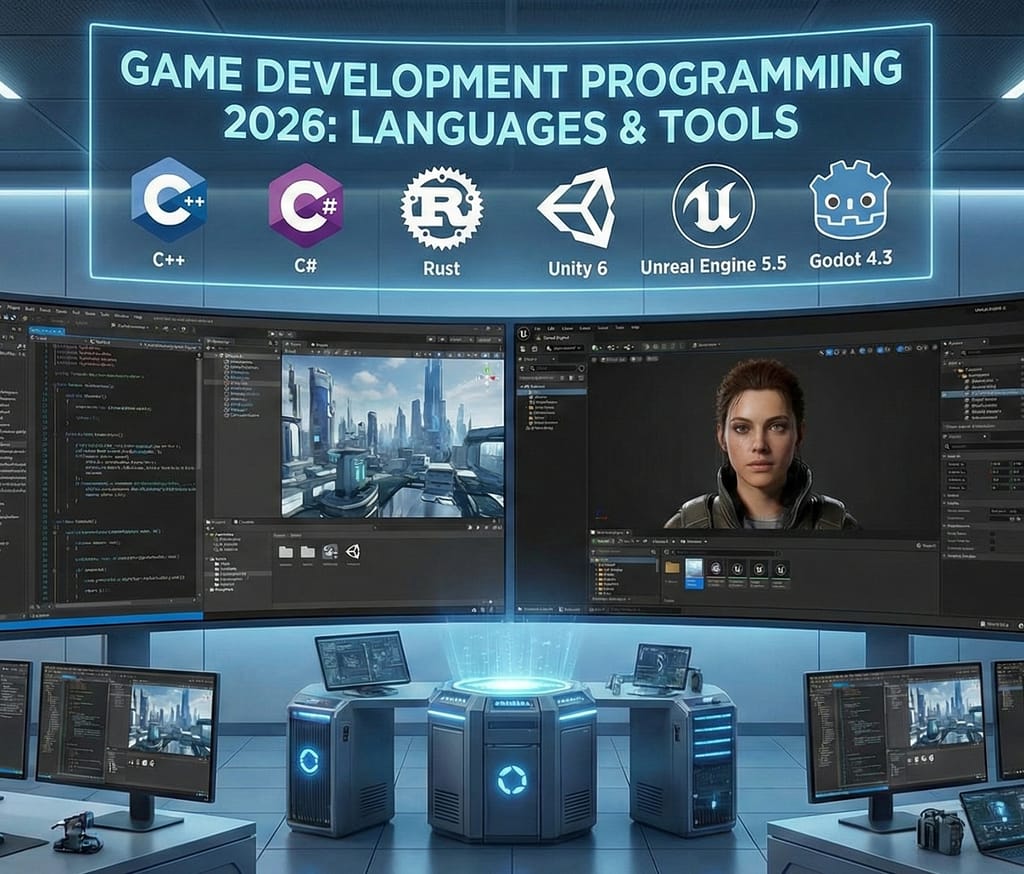

The gaming industry in 2026 is larger than ever. From mobile games and indie titles to AAA console releases and immersive virtual reality experiences, game development has evolved into one of the most exciting areas of programming.
But behind every successful game lies powerful programming languages and development tools.
Game development programming in 2026 combines performance-focused languages, advanced engines, real-time rendering technologies, artificial intelligence systems, and cross-platform frameworks.
This guide explores the major programming languages, engines, tools, and career opportunities shaping modern game development.
What Is Game Development Programming?
Game development programming involves writing code that controls:
- Game logic
- Physics systems
- Character behavior
- Artificial intelligence
- Graphics rendering
- Multiplayer networking
- User interaction
Game programmers transform creative ideas into interactive digital worlds.
Core Programming Languages Used in Game Development (2026)
Different types of games require different tools and languages. The most widely used languages include:
- C++
- C#
- Python
- JavaScript
Let’s explore how each is used.
C++: The Powerhouse of AAA Games
C++ remains one of the most important languages in high-performance game development.
It is widely used because:
- It provides low-level memory control
- It offers high performance
- It supports complex game engines
- It handles real-time physics efficiently
Most AAA (big-budget) games use C++ due to its speed and performance capabilities.
C++ is heavily used in engines like:
- Unreal Engine
Unreal Engine is known for:
- High-end graphics
- Realistic physics
- Cinematic rendering
- Open-world game capabilities
Major console and PC games rely on Unreal Engine and C++ for performance-critical systems.
C#: The Language Behind Unity
C# plays a central role in modern game development, especially in indie and mobile gaming.
It is primarily used with:
- Unity
Unity is one of the most popular game engines in 2026.
Why Unity Is Popular
| Feature | Benefit |
|---|---|
| Cross-Platform Support | Build for PC, mobile, console |
| Beginner-Friendly | Easier learning curve |
| Large Community | Massive asset marketplace |
| Strong Documentation | Ideal for students |
Unity is widely used for:
- Mobile games
- 2D games
- Indie projects
- AR/VR development
C# provides a balance between performance and simplicity.
Unreal Engine vs Unity in 2026
Both engines dominate the industry but serve slightly different goals.
| Feature | Unity | Unreal Engine |
|---|---|---|
| Primary Language | C# | C++ |
| Graphics Quality | Good | Excellent |
| Learning Curve | Easier | Moderate to Advanced |
| Mobile Support | Strong | Moderate |
| AAA Games | Limited | Very Strong |
If performance and high-end visuals matter most → Unreal Engine
If flexibility and ease of use matter → Unity
Python in Game Development
While not used for core game engines, Python plays an important role in:
- Game scripting
- AI behavior systems
- Automation tools
- Game testing
Python is also used in game development pipelines for asset management and content automation.
JavaScript and Web-Based Games
JavaScript powers browser-based and lightweight online games.
Game engines and libraries in the web ecosystem allow developers to build:
- HTML5 games
- Interactive browser experiences
- Casual multiplayer web games
Web-based gaming continues growing in 2026 due to cloud gaming integration.
Game Engines in 2026
Game engines simplify development by providing built-in systems for:
- Rendering
- Physics
- Audio
- Animation
- Input handling
The most widely used engines include:
- Unity
- Unreal Engine
- Godot
Godot: The Open-Source Alternative
Godot is gaining popularity because:
- It is open-source
- It supports 2D and 3D development
- It has a lightweight environment
- It uses its own scripting language
Godot is popular among indie developers and small teams.
Game Development for Different Platforms
Game development varies depending on the target platform.
Mobile Game Development
- Focus on performance optimization
- Touch interface design
- Smaller screen UI
- Monetization via ads and in-app purchases
Unity dominates mobile development.
PC and Console Game Development
- High graphics requirements
- Complex physics engines
- Multiplayer infrastructure
- Advanced animation systems
Unreal Engine is heavily used for console games.
VR and AR Game Development
Virtual and augmented reality development continues expanding.
Unity and Unreal Engine both support:
- VR headset integration
- Real-time 3D rendering
- Immersive interaction systems
Multiplayer and Online Gaming Programming
Modern games often include online multiplayer features.
This requires:
- Networking systems
- Real-time data synchronization
- Anti-cheat systems
- Server management
Game developers must understand backend programming as well.
AI in Game Development (2026)
Artificial intelligence is heavily integrated into modern games.
AI systems control:
- NPC behavior
- Enemy decision-making
- Adaptive difficulty
- Procedural world generation
Game AI makes gameplay dynamic and realistic.
Tools Used in Game Development
Beyond programming languages and engines, developers use additional tools:
| Tool Type | Purpose |
|---|---|
| Version Control | Team collaboration |
| 3D Modeling Software | Character & environment design |
| Audio Tools | Sound design |
| Animation Software | Motion capture |
Game development is highly collaborative.
Career Scope in Game Development
Game development offers various career paths:
- Game Programmer
- Gameplay Engineer
- Graphics Programmer
- AI Developer
- Level Designer
- Technical Artist
The gaming industry continues expanding globally.
Salary and Industry Growth
Game developers are in demand due to:
- Growth of esports
- Expansion of mobile gaming
- Rise of cloud gaming
- Increased VR adoption
AAA studios, indie companies, and startups all hire skilled developers.
Challenges in Game Development
Game programming is demanding because:
- It requires strong logic skills
- Performance optimization is complex
- Debugging large systems is difficult
- Team collaboration is essential
Game development combines creativity with technical depth.
Future of Game Development Programming
Looking beyond 2026, trends include:
- AI-generated game content
- Cloud-based development pipelines
- Cross-platform engines
- Real-time global multiplayer systems
- Metaverse-style virtual environments
Game development will continue merging technology and creativity.
Final Conclusion
Game Development Programming in 2026 relies heavily on powerful languages like C++ and C#, along with advanced engines such as Unity and Unreal Engine. While C++ dominates high-performance AAA games, C# and Unity lead in mobile and indie development.
The gaming industry continues to grow, offering exciting career opportunities across multiple platforms and technologies. Whether building mobile games, console titles, or VR experiences, mastering game programming opens doors to one of the most dynamic fields in technology.
For aspiring developers, choosing the right engine and language depends on career goals, target platforms, and desired game type.