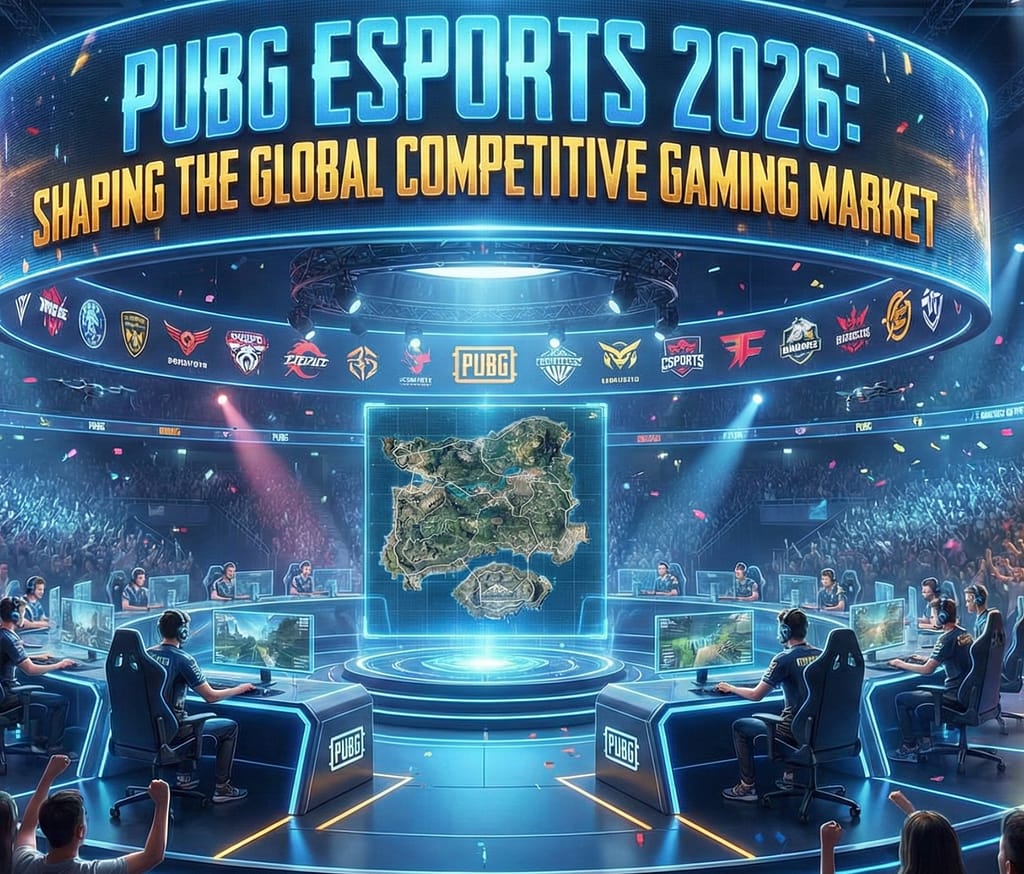

The evolution of competitive gaming has radically transformed the global entertainment industry, and PUBG Esports in 2026 stands as one of the most profound examples of this transformation. PlayerUnknown’s Battlegrounds (PUBG) is no longer just the title that popularized the battle royale genre—it has matured into a multi-tiered, globally connected esports ecosystem. Today, it actively influences digital culture, sets new competitive gaming standards, and drives a significant portion of the broader esports economy.
In 2026, PUBG and its mobile counterpart, PUBG Mobile, hold a commanding position in the esports industry. Backed by structured regional and global tournaments, franchised professional teams, multi-million dollar prize pools, and an audience of millions, the game has proven its staying power. Its impact extends far beyond the server, driving economic growth, elevating streaming platforms, securing massive digital sponsorships, and cultivating emerging gaming markets like never before.
This in-depth article explores exactly how PUBG shapes the esports market in 2026. We will dive into its controversial yet revolutionary format changes, the sprawling structure of its competitive ecosystem, its highly lucrative revenue generation models, and its future growth potential.
1. The Genesis: From Survival Mod to Global Esports Juggernaut
To understand PUBG’s dominance in 2026, we must look at its origins. PUBG introduced large-scale, 100-player battle royale gameplay to mainstream audiences. The raw concept of survival-based competition, strategic positioning, and highly unpredictable match outcomes made it a natural fit for the high-stakes world of esports.
Unlike traditional arena shooters (like Counter-Strike or Valorant), PUBG emphasizes a unique blend of skills:
- Tactical Movement and Macro-Rotations: Navigating a massive 8x8km map safely.
- Team Coordination: Splitting resources and holding multi-angle defensive pervens.
- Resource Management: Rationing medical supplies, utility (smoke grenades), and ammunition.
- Survival Strategy: Knowing when to fight and when to hide to maximize placement points.
- Dynamic Zone Control: Adapting to RNG (Random Number Generation) blue zone shifts.
These elements create suspense-driven matches that attract massive spectator numbers. PUBG’s realistic gameplay style and punishing gun mechanics distinctly separate it from arcade-style battle royales, demanding a heavily strategy-focused approach from professional players.
2. The 2026 PUBG PC Revolution: The Shift to TPP
The 2026 season marks what publisher KRAFTON calls “A New Era.” Over the past seven years, the PC competitive scene was primarily played in First-Person Perspective (FPP). However, 2026 introduced a monumental shift: PUBG Esports officially transitioned to Third-Person Perspective (TPP).
While this move initially sparked intense debate among hardcore purists, the analytical reasoning behind it is sound. Of the 1 billion players who have experienced PUBG globally, the vast majority play in TPP. KRAFTON realized that the gap between playing the game casually and watching it professionally was too wide.
By unifying the competitive scene with the casual player base’s preferred perspective, PUBG Esports in 2026 has become infinitely more accessible, relatable, and immersive. This change was heavily tested throughout 2025 via the PUBG Players Tour (PPT), proving that TPP tournaments could maintain high-skill ceilings while drastically boosting viewership retention among everyday players.
3. The PUBG Esports Structure in 2026
PUBG Esports 2026 operates under a meticulously structured, season-long framework designed to minimize downtime and maximize high-stakes action from March through December.
Regional Leagues and Grassroots Qualifiers
Regional leagues are the lifeblood of the ecosystem. The 2026 model introduced a “scrims to global” pipeline. Anyone can start in regional Scrims, progress to Regional Cups, and advance to the Regional Series. Key regions include the Americas, EMEA (Europe, Middle East, Africa), Asia (Korea, China), and APAC (Thailand, Vietnam).
The PUBG Global Series (PGS)
The pinnacle of the year-round circuit is the PUBG Global Series. In 2026, the calendar features four Global Circuits, each containing three weekly series (totalling 12 tournaments). These events feature a $2 million combined prize pool. The series uses a compounding format where teams fight through weekly stages, carrying their momentum into a final week to crown a Circuit Champion.
Global Partner Teams Program
Financial stability is crucial for esports organizations. In 2026, PUBG finalized 12 Global Partner Teams—including heavyweights like Gen.G, 17 Gaming, Natus Vincere (NAVI), Twisted Minds, and Team Falcons. These teams receive guaranteed entry into all PGS events, revenue sharing from exclusive in-game team skins, and over $1 million in annual financial support from KRAFTON.
The Crowning Events: PNC, EWC, and PGC
The year is punctuated by three massive international LANs:
- PUBG Nations Cup (PNC) in June: A World Cup-style event where players represent their countries rather than their orgs.
- Esports World Cup (EWC) in July: Held in Riyadh, Saudi Arabia, featuring a massive multi-million dollar prize pool.
- PUBG Global Championship (PGC) in December: The grand finale where the top 16 teams in the world fight for the ultimate crown.
4. PUBG Mobile: The $7 Million Esports Goliath
While PC gaming drives the prestige, PUBG Mobile is the engine driving unparalleled global growth. Mobile accessibility has allowed millions of players to compete without needing a $2,000 gaming rig, fueling an esports boom in developing and emerging markets.
In 2026, the PUBG Mobile esports roadmap is staggering, boasting over $7 million in major event prize pools.
The PMGO Expansion
2026 features two massive PUBG Mobile Global Open (PMGO) events. Season 1’s main event takes place in Indonesia in June, while Season 2 heads to Pakistan in October—both featuring $500,000 prize pools. These events utilize a brilliant “Road to PMGO” format. It begins with in-game qualifiers open to players from over 200 countries, ensuring true grassroots representation, before filtering down to national and regional finals.
PMWC and PMGC
In July, PUBG Mobile features at the Esports World Cup in Riyadh with the PUBG Mobile World Cup (PMWC), throwing 32 teams into a $3 million battle. Finally, the year concludes with the PUBG Mobile Global Championship (PMGC) in Turkiye, where 39 teams will compete for another $3 million prize pool.
PUBG Mobile utterly dominates viewership in India, South Asia, Southeast Asia, and the Middle East, making it one of the most inclusive and widely-watched competitive titles on the planet.
5. Revenue Streams: The Esports Economy
The esports market surrounding PUBG generates sustainable revenue through a diversified portfolio of channels, protecting it from the “esports winter” that has plagued other titles.
1. Sponsorship and Advertising
Global brands flock to PUBG’s massive demographic. Endemic brands (tech hardware, peripherals) and non-endemic brands (energy drinks, automotive, apparel) sponsor professional teams, tournament events, and stadium broadcasts. Team Falcons, Gen.G, and NAVI operate as massive standalone businesses fueled by these partnerships.
2. Media and Streaming Rights
Live tournament broadcasts generate immense revenue through localized broadcasting rights. Platforms like YouTube, Twitch, and regional giants (like SOOP in Korea) pay for premium content features, exclusive broadcast rights, and targeted advertising integration during matches.
3. In-Game Esports Integration (Digital Merchandising)
PUBG masterfully integrates esports into the actual game. Through the Esports Pass, Fantasy Leagues, and Pick’em Challenges, fans purchase in-game cosmetics, team-branded weapon skins, and supporter packs. A large percentage of these sales is shared directly with the Global Partner Teams, creating a direct financial link between fan passion and team sustainability.
4. Tournament Prize Pools
While prize pools are an expense for publishers, they act as a massive revenue stream for players and organizations. Earning a cut of a $3 million PMGC prize pool can fund an emerging esports organization for years, validating professional gaming as a lucrative career.
6. The Growth of Esports Viewership & Engagement
PUBG Esports 2026 benefits from an ever-expanding global viewership, largely driven by its integration of interactive viewing experiences.
Live streaming is no longer a passive experience. Competitive matches generate high social media engagement through real-time chat interactions and community-driven content. In 2026, the introduction of the official PUBG Esports Fantasy League transformed how fans watch. Just like fantasy football, viewers draft professional players and earn points based on their real-time performance (kills, assists, placement).
This gamification of viewership keeps audiences glued to the broadcast, even if their favorite team is eliminated early in a match. Higher, more consistent viewership metrics directly strengthen the esports economy, allowing organizers to negotiate better brand partnerships.
7. Competitive Strategy: The Chess Match of 2026
To the untrained eye, battle royales look chaotic. To a professional PUBG analyst in 2026, it is a highly calculated game of chess. Professional PUBG requires advanced strategic planning and split-second adaptability.
Teams focus on:
- Map Awareness & Topography: Memorizing every dip, ridge, and compound on maps like Erangel, Miramar, Taego, and Rondo.
- Safe Zone Prediction: Using historical data to guess where the final circles will pull.
- Rotation Timing: Deciding exactly when to drive into the zone to avoid being “gatekept” by enemy teams.
- Utility Usage: Perfectly coordinating smoke walls and flashbangs to cross open terrain.
Unlike casual gameplay, esports-level PUBG is fiercely data-driven. Teams employ full-time analysts who study opponent drop spots, loot paths, and rotation tendencies, allowing In-Game Leaders (IGLs) to make highly educated macro-decisions on the fly.
8. The Role of Technology in Broadcasts and Gameplay
Technological advancements are the unsung heroes of PUBG’s competitive ecosystem. Running a 64-player (16 teams of 4) PC lobby, or a mobile lobby, requires immense server stability.
Key technological drivers in 2026 include:
- High-Tick-Rate Servers: Ensuring that hit registration is flawless and bullet physics (bullet drop and travel time) operate exactly as intended.
- 120FPS Mobile Gaming: High-performance mobile processors have elevated PUBG Mobile to a true competitive standard, removing hardware bottlenecks.
- Anti-Cheat AI Systems: Machine learning algorithms monitor competitive lobbies in real-time to maintain absolute competitive integrity.
- Advanced Observer Tools: Broadcasts utilize AI-assisted cameras that predict where gunfights will happen, ensuring the audience never misses crucial action across the massive maps.
9. Empowering Emerging Esports Markets
Emerging markets are absolutely critical to PUBG’s 2026 expansion strategy. While traditional esports have historically focused on North America, Western Europe, and Korea, PUBG has successfully decentralized the industry.
By hosting major 2026 events in Pakistan (PMGO), Indonesia (PMGO), Saudi Arabia (EWC), and Turkiye (PMGC), KRAFTON is directly injecting capital into developing esports ecosystems. Affordable smartphones and rapidly expanding 5G internet infrastructure mean that a teenager in rural Southeast Asia has the exact same competitive opportunity as a player in Seoul or Los Angeles.
These local tournaments encourage youth engagement, develop regional talent, and foster a deep sense of community-driven growth that Western-centric titles often struggle to replicate.
10. Expanding Career Opportunities
The 2026 PUBG esports ecosystem supports thousands of professional roles far beyond just the people holding the controllers or mice. The industry now provides structured, long-term career paths.
These roles include:
- Professional Players & Substitutes
- Head Coaches & Strategic Analysts
- Event Organizers & Tournament Admins
- Shoutcasters, Color Commentators, and Stage Hosts
- Broadcast Directors and In-Game Observers
- Social Media Managers & Content Creators
By providing stipends and revenue sharing to partner teams, KRAFTON has ensured that individuals can confidently build life-long careers in the PUBG ecosystem.
11. The Economic Impact on the Broader Industry
PUBG’s massive footprint actively contributes to the broader global esports economy. The demand for high-tier tournaments boosts local economies when thousands of fans travel for LAN events. It encourages digital entrepreneurship, prompting the creation of new esports organizations, merchandise companies, and content agencies.
Furthermore, it drives gaming infrastructure investment. Telecom companies push for better fiber-optic and 5G networks, and hardware manufacturers innovate to meet the demands of PUBG’s massive player base. The esports market as a whole benefits from PUBG’s stable framework, which serves as a blueprint for how to monetize a massive free-to-play player base.
12. Surviving the Drop: Challenges Facing PUBG Esports
Despite its monumental growth, the 2026 season is not without its challenges.
- The TPP vs. FPP Divide: While moving to Third-Person Perspective united the casual and pro scenes, it alienated a vocal minority of hardcore PC esports purists. Managing this community sentiment remains an ongoing task.
- Market Saturation: Competition from newer battle royale titles, hero shooters, and extraction shooters constantly threatens to siphon away viewership.
- Regulatory Restrictions: Different countries have varying laws regarding digital monetization, loot boxes, and esports prize money, requiring KRAFTON to navigate a complex web of international law.
- Anti-Cheat Integrity: As cheat developers use increasingly advanced AI to bypass security, maintaining a 100% fair competitive environment is an expensive, never-ending arms race.
However, KRAFTON’s structured governance and willingness to adapt have historically kept the game stable through turbulent times.
13. PUBG vs. Other Battle Royale Titles
What makes PUBG survive when dozens of other battle royales have died? It comes down to differentiation.
While titles like Apex Legends or Fortnite rely on fast-paced movement abilities, hero powers, or building mechanics, PUBG remains grounded in tactical realism. The realistic gunplay, where bullet drop, velocity, and recoil must be mastered, rewards true mechanical skill.
Furthermore, PUBG’s competitive scoring depth—which heavily balances survival placement points with aggressive kill points—prevents matches from becoming boring hide-and-seek games while still punishing reckless aggression. Its structured global partner format provides an organizational stability that other BR games desperately lack.
14. Future Outlook: Beyond 2026
Looking beyond 2026, the ceiling for PUBG Esports remains incredibly high. Future expansions may include enhanced cross-platform ecosystem integrations, allowing mobile and PC esports fans to interact in unified virtual fan-zones. We will likely see the implementation of advanced spectator analytics, where viewers can pull up a player’s real-time heart rate, eye-tracking, and APM (Actions Per Minute) on their own screens.
As augmented reality (AR) and virtual reality (VR) broadcasting mature, fans may soon be able to put on a headset and “stand” inside the final circle of a PUBG Global Championship match. As long as the battle royale genre remains a staple of gaming, PUBG will remain its most influential competitive pioneer.
Conclusion
PUBG Esports in 2026 is a masterclass in how to build, scale, and sustain a global competitive ecosystem. Through brilliant mobile accessibility, structured regional league systems, massive global championships, and heavily integrated digital sponsorship models, PUBG remains an undeniable powerhouse.
Its influence has spilled far beyond the boundaries of a video game, shaping digital economies, providing thousands of employment opportunities, and redefining modern streaming culture. While challenges in maintaining player sentiment and competitive integrity will always exist, the incredibly structured growth of both PUBG PC and PUBG Mobile ensures their relevance for years to come.
For gaming enthusiasts, professional players, and industry investors alike, PUBG in 2026 represents far more than just a battle royale. It is a mature, thriving esports economy driving the future of global competitive entertainment.