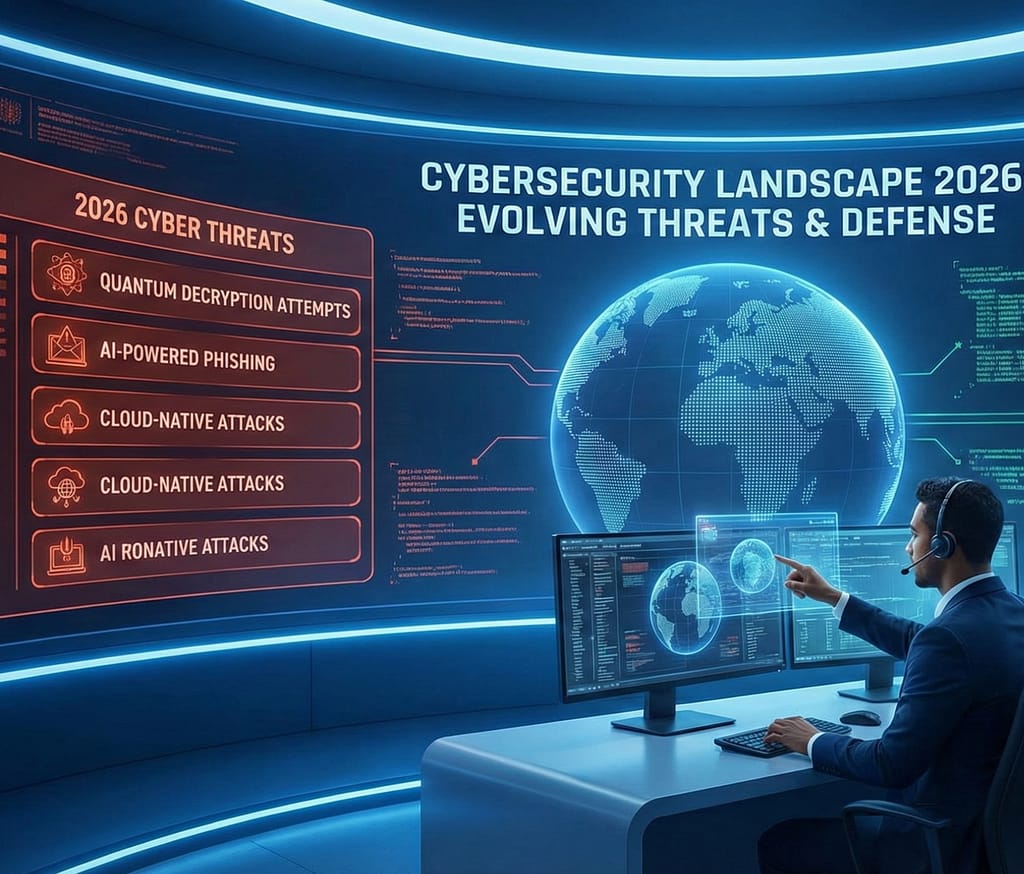

The digital world in 2026 is more connected than ever before. Businesses rely on cloud platforms, artificial intelligence systems, remote work infrastructure, smart devices, and global data exchanges. While technology has created massive opportunities, it has also expanded the attack surface for cybercriminals.
Cybersecurity Threats in 2026 have become more sophisticated, automated, and financially motivated. From ransomware attacks to AI-powered phishing scams, organizations face constant risks. As a result, cybersecurity is no longer just an IT issue — it is a core business priority.
This article explores the major cybersecurity threats in 2026 and the strategies companies are using to protect sensitive data and maintain digital trust.
The Changing Cybersecurity Landscape
Over the past decade, cyber threats have evolved significantly. Attackers are no longer isolated hackers; many operate as organized groups with advanced tools and global networks.
Key factors contributing to increased cybersecurity threats include:
- Expansion of remote work environments
- Increased cloud adoption
- Rapid AI development
- Growth of Internet of Things (IoT) devices
- Digital transformation across industries
The more digital systems expand, the more vulnerabilities may appear.
Major Cybersecurity Threats in 2026
1. Ransomware Attacks
Ransomware remains one of the most dangerous cybersecurity threats in 2026.
In a ransomware attack, cybercriminals encrypt a company’s data and demand payment for restoration. Modern ransomware attacks are more complex and may include:
- Data theft before encryption
- Public data leaks
- Targeted attacks on critical infrastructure
Organizations across healthcare, finance, and manufacturing sectors remain primary targets.
2. AI-Powered Cyber Attacks
Artificial intelligence is not only used for innovation — it is also being exploited by cybercriminals.
AI-driven threats include:
- Automated phishing emails
- Deepfake voice impersonation
- Intelligent malware that adapts to defenses
- Automated vulnerability scanning
AI allows attackers to launch more convincing and large-scale attacks.
3. Phishing and Social Engineering
Phishing remains one of the most common entry points for cyber attacks.
In 2026, phishing emails are more personalized and harder to detect. Attackers may use:
- AI-generated email content
- Fake company domains
- Deepfake video calls
- Impersonation of executives
Social engineering attacks exploit human behavior rather than technical weaknesses.
4. Cloud Security Vulnerabilities
As companies move data to cloud platforms, new security challenges arise.
Common cloud-related threats include:
- Misconfigured storage systems
- Weak access controls
- Compromised credentials
- Insider threats
Cloud security requires continuous monitoring and strict configuration management.
5. Internet of Things (IoT) Exploits
IoT devices are widely used in homes, factories, and smart cities.
However, many IoT devices have limited security features. Weak passwords and outdated firmware make them vulnerable.
Cybercriminals may use compromised IoT devices to:
- Launch distributed denial-of-service (DDoS) attacks
- Access sensitive networks
- Disrupt industrial systems
6. Supply Chain Attacks
Supply chain attacks target third-party vendors to access larger organizations.
Attackers compromise smaller companies with weaker defenses and use them as entry points to bigger enterprises.
This makes vendor security assessment critical.
How Companies Are Protecting Data in 2026
To counter Cybersecurity Threats in 2026, organizations are implementing advanced defense strategies.
1. Zero Trust Security Model
The Zero Trust approach assumes that no user or device is automatically trusted.
Under this model:
- Every access request is verified
- Multi-factor authentication is mandatory
- Continuous monitoring is applied
Zero Trust significantly reduces unauthorized access risks.
2. AI-Based Threat Detection
Just as attackers use AI, companies use AI-powered security systems.
AI security tools can:
- Detect unusual behavior patterns
- Identify anomalies in network traffic
- Automatically respond to threats
Machine learning helps security systems learn and improve over time.
3. Multi-Factor Authentication (MFA)
MFA has become a standard security measure.
It requires users to verify identity through:
- Passwords
- One-time codes
- Biometric authentication
- Hardware tokens
MFA significantly reduces credential-based attacks.
4. Regular Security Audits and Testing
Organizations conduct:
- Penetration testing
- Vulnerability assessments
- Risk analysis
These tests identify weaknesses before attackers can exploit them.
5. Employee Cybersecurity Training
Human error remains a major cause of breaches.
Companies invest in employee training programs to:
- Recognize phishing emails
- Avoid suspicious links
- Follow secure password practices
- Report unusual activity
Cybersecurity awareness reduces social engineering risks.
6. Data Encryption and Backup Strategies
Data encryption protects information even if it is intercepted.
Companies encrypt:
- Stored data
- Transmitted data
- Sensitive communications
Regular data backups ensure business continuity in case of ransomware attacks.
7. Secure Cloud Infrastructure
Cloud providers offer advanced security features, but organizations must configure them properly.
Companies implement:
- Access management controls
- Secure API gateways
- Continuous cloud monitoring
Cloud security is a shared responsibility between provider and customer.
Regulatory Compliance and Legal Protection
Governments worldwide are introducing stricter data protection laws.
Companies must comply with regulations related to:
- Personal data protection
- Financial data security
- Healthcare information privacy
Non-compliance can result in heavy fines and reputational damage.
Compliance frameworks encourage stronger cybersecurity standards.
The Role of Cybersecurity Teams
In 2026, cybersecurity is a strategic function.
Organizations hire:
- Chief Information Security Officers (CISOs)
- Security analysts
- Incident response teams
- Threat intelligence experts
Cybersecurity teams work continuously to monitor, detect, and respond to threats.
Cybersecurity in Small and Medium Businesses
Cyber threats do not only target large corporations.
Small and medium businesses are often targeted because:
- They have weaker defenses
- They may lack dedicated security teams
- They store valuable customer data
Affordable cybersecurity solutions and managed security services help smaller organizations improve protection.
The Economic Impact of Cyber Attacks
Cyber attacks cause:
- Financial losses
- Operational downtime
- Reputation damage
- Legal liabilities
Investing in cybersecurity is no longer optional; it is essential for business survival.
The Future of Cybersecurity Beyond 2026
Looking ahead, cybersecurity will continue evolving.
Future trends may include:
- Quantum-resistant encryption
- Fully automated threat response systems
- AI-driven predictive security
- Decentralized identity management
Organizations must remain adaptable to address emerging threats.
Conclusion
Cybersecurity Threats in 2026 are more advanced and complex than ever before. From AI-powered attacks and ransomware to cloud vulnerabilities and IoT risks, companies face constant challenges.
However, organizations are responding with stronger defense strategies, including Zero Trust models, AI-based monitoring, encryption, and employee training.
As digital transformation accelerates, cybersecurity will remain one of the most critical priorities for businesses worldwide. Protecting data is not just about technology — it is about maintaining trust, stability, and long-term growth.
For readers of Digital Technologia, staying informed about cybersecurity trends is essential in navigating the modern digital world safely.