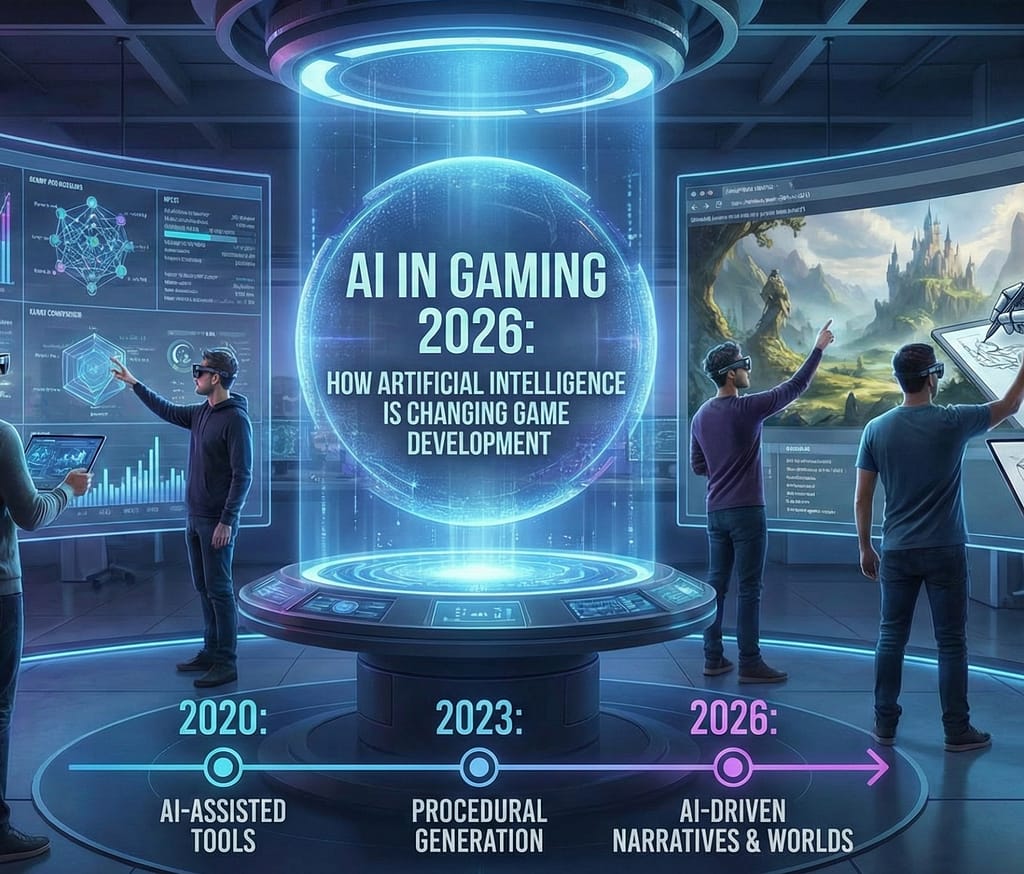

Artificial Intelligence is transforming nearly every industry — and gaming is one of the most exciting areas of change. In 2026, AI in gaming is no longer limited to simple enemy behavior or scripted actions. Instead, artificial intelligence is now driving game design, world-building, character interaction, animation, testing, and even storytelling.
AI in Gaming 2026 represents a major shift in how games are created and experienced. From smarter non-playable characters (NPCs) to procedurally generated worlds and AI-assisted development tools, artificial intelligence is reshaping the entire gaming ecosystem.
This in-depth article explores how AI is changing game development, improving gameplay realism, enhancing player experience, supporting developers, and shaping the future of interactive entertainment.
The Evolution of AI in Gaming
AI has existed in games for decades. Early examples included:
- Scripted enemy movements
- Basic pathfinding systems
- Predictable NPC reactions
Older games used rule-based programming. Enemies followed fixed patterns. Once players learned those patterns, gameplay became predictable.
In 2026, AI systems are far more advanced. Modern games use machine learning models, behavior trees, neural networks, and real-time decision systems.
AI is now adaptive rather than static.
Smarter NPCs and Realistic Behavior
One of the biggest impacts of AI in gaming is improved NPC intelligence.
Modern AI allows NPCs to:
- Adapt to player strategies
- Communicate dynamically
- Use environmental advantages
- React realistically to threats
For example, in competitive shooters like Call of Duty: Warzone and Valorant, AI-driven training bots simulate realistic combat patterns to help players improve.
NPCs are no longer robotic. They behave more like real opponents.
Procedural Content Generation
AI-powered procedural generation creates:
- Open-world environments
- Dungeons
- Landscapes
- Missions
- Dialogue variations
Instead of developers manually designing every element, AI systems generate dynamic content.
This increases replay value and reduces repetitive gameplay.
In large-scale RPGs and sandbox games, AI-generated environments expand immersion.
AI-Driven Storytelling
One of the most exciting advancements in AI in Gaming 2026 is dynamic storytelling.
AI can:
- Adapt storylines based on player decisions
- Generate dialogue variations
- Create branching narrative paths
- Adjust character relationships dynamically
Instead of linear storytelling, players experience personalized narratives.
Future games may use AI to generate entirely unique story arcs.
AI in Game Design and Development
AI is not only affecting gameplay — it is transforming how games are built.
Developers use AI tools for:
- Level design automation
- Bug detection
- Animation smoothing
- Voice synthesis
- Asset generation
AI-assisted development reduces production time and cost.
This allows smaller studios to compete with larger companies.
Machine Learning for Player Behavior Analysis
Game studios use machine learning to analyze player data.
AI helps developers understand:
- Player engagement patterns
- Drop-off points
- Skill progression
- In-game economy behavior
This data improves game balancing and updates.
Competitive games such as League of Legends use analytics to adjust character balance and maintain fairness.
Anti-Cheat Systems Powered by AI
Cheating is a major issue in online gaming.
AI-powered anti-cheat systems monitor:
- Suspicious movement patterns
- Unusual accuracy rates
- Unauthorized software behavior
Machine learning models detect cheating behavior faster than manual systems.
AI strengthens fair play in competitive gaming.
Realistic Graphics and Animation
AI improves graphics rendering through:
- AI upscaling
- Real-time ray tracing optimization
- Animation blending
- Facial expression generation
This creates more immersive gaming experiences.
Players now experience cinematic-quality visuals in real time.
Voice AI and Interactive Dialogue
AI-driven voice systems enable:
- Natural conversations with NPCs
- Voice recognition-based gameplay
- Real-time dialogue generation
Future RPGs may allow players to speak freely rather than select preset dialogue options.
This level of immersion was impossible in earlier generations.
AI and Open-World Exploration
Open-world games benefit greatly from AI.
AI manages:
- Dynamic weather systems
- Wildlife behavior
- Crowd simulations
- Traffic systems
Large cities feel alive because AI controls thousands of small interactions.
AI in Game Testing and Quality Assurance
Game testing used to require large teams manually identifying bugs.
Now AI systems can:
- Automatically test gameplay scenarios
- Detect collision errors
- Identify performance bottlenecks
AI reduces development delays.
AI in Esports and Competitive Gaming
AI tools assist esports players by:
- Analyzing gameplay performance
- Reviewing strategic decisions
- Tracking opponent behavior
Coaches use AI-generated analytics to refine strategies.
AI also helps broadcasters provide real-time match statistics.
Ethical Concerns and AI Challenges
Despite benefits, AI in gaming raises concerns.
Issues include:
- Data privacy
- AI bias
- Over-automation in creativity
- Player dependency on adaptive systems
Developers must balance AI efficiency with creative originality.
The Impact of Generative AI
Generative AI is reshaping asset creation.
AI tools can generate:
- Textures
- 3D models
- Sound effects
- Dialogue scripts
This reduces development costs but raises questions about originality and intellectual property.
Future of AI in Gaming Beyond 2026
Future developments may include:
- Fully AI-generated open worlds
- Real-time personalized game mechanics
- Advanced AI companions
- Emotion-detecting gameplay systems
Games may adapt dynamically to player mood and behavior.
Is AI Replacing Game Developers?
AI is not replacing developers — it is assisting them.
Human creativity remains essential.
AI tools support efficiency, but storytelling, art direction, and design vision require human oversight.
The future of game development is collaboration between humans and AI systems.
Final Conclusion
AI in Gaming 2026 is fundamentally transforming the gaming industry. From smarter NPCs and procedural world generation to AI-assisted development tools and advanced anti-cheat systems, artificial intelligence enhances both game creation and player experience.
While challenges exist, AI-driven innovation is accelerating game development and increasing realism. Rather than replacing human creativity, AI is empowering developers to build more immersive and dynamic worlds.
For readers of Digital Technologia, understanding AI in gaming means understanding the future of interactive entertainment.