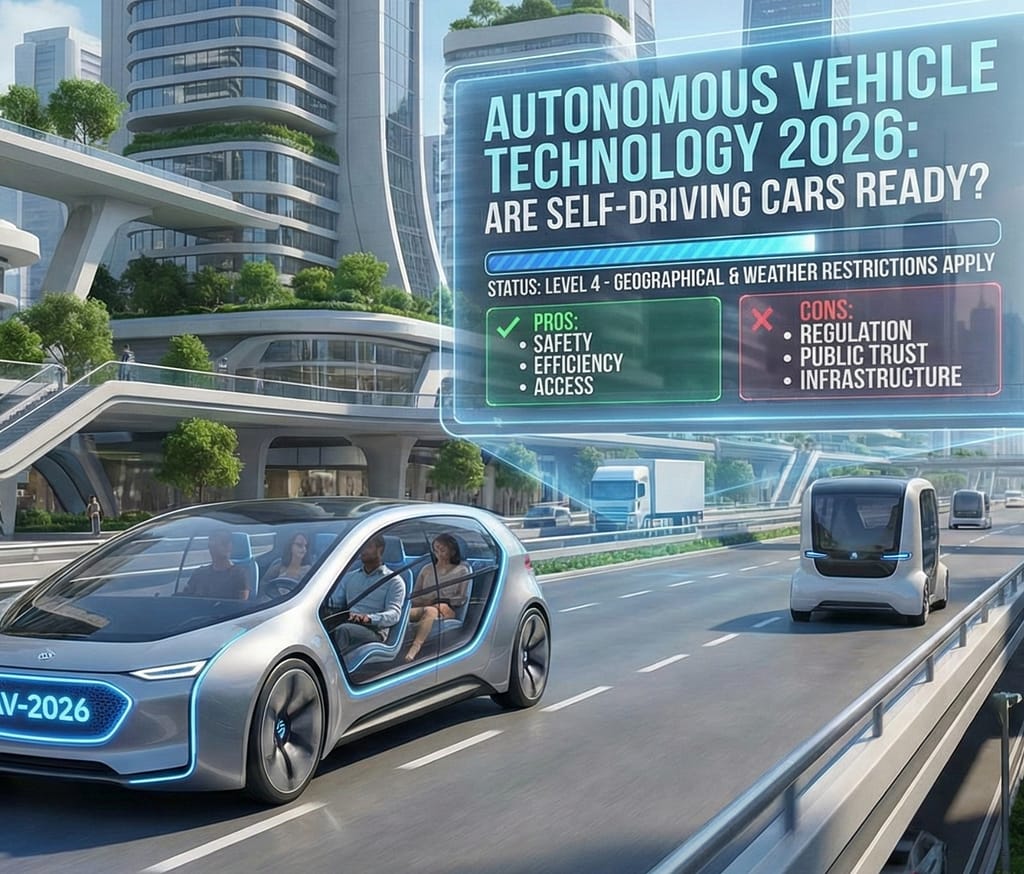

Autonomous driving has long been considered one of the most revolutionary advancements in transportation. In 2026, autonomous vehicle technology is no longer a futuristic idea—it is being tested, deployed, and refined across multiple countries. Major automotive manufacturers and technology companies are investing billions into developing fully self-driving systems.
But the question remains: Are self-driving cars truly ready for widespread adoption?
Autonomous Vehicle Technology 2026 represents a critical stage in the evolution of transportation. With rapid advancements in artificial intelligence, sensor technology, machine learning, and vehicle connectivity, autonomous systems are becoming smarter and safer. However, technical challenges, regulatory concerns, and public trust issues still remain.
This detailed analysis explores how autonomous vehicles work, their current development stage, industry leaders, benefits, risks, legal challenges, and what the future holds.
What Is Autonomous Vehicle Technology?
Autonomous vehicles (AVs) are cars capable of sensing their environment and operating without human intervention. These vehicles rely on a combination of:
- Artificial intelligence (AI)
- Cameras
- Radar systems
- LiDAR sensors
- GPS mapping
- Real-time data processing
The goal of autonomous driving technology is to reduce human error, improve safety, and create a more efficient transportation system.
Levels of Autonomous Driving
Self-driving vehicles are categorized into different levels, from Level 0 to Level 5.
Level 0: No Automation
The driver controls all aspects of driving.
Level 1: Driver Assistance
Basic features like cruise control or lane assist.
Level 2: Partial Automation
The vehicle can steer and accelerate but requires driver supervision.
Level 3: Conditional Automation
The vehicle can handle certain conditions independently but may request driver takeover.
Level 4: High Automation
The vehicle can operate independently in most environments.
Level 5: Full Automation
No steering wheel or pedals required. Completely driverless.
In 2026, most commercially available systems operate between Level 2 and Level 4.
How Self-Driving Cars Work
Autonomous vehicles rely on complex systems working together.
1. Sensors and Perception
Vehicles use:
- Cameras to detect traffic signs and lane markings
- Radar to measure distance from other vehicles
- LiDAR to create 3D maps of surroundings
These sensors collect real-time data about the vehicle’s environment.
2. Artificial Intelligence and Machine Learning
AI algorithms process sensor data and make driving decisions.
The system evaluates:
- Road conditions
- Traffic patterns
- Pedestrian movement
- Obstacle detection
Machine learning allows the system to improve over time by analyzing millions of driving scenarios.
3. Mapping and Navigation
High-definition maps provide detailed road information.
Autonomous vehicles use:
- GPS positioning
- Real-time traffic data
- Pre-mapped routes
These systems allow accurate route planning and obstacle prediction.
Industry Leaders in Autonomous Vehicle Development
Several major companies are leading autonomous vehicle innovation:
- Global automobile manufacturers
- Technology companies specializing in AI
- Ride-sharing companies investing in driverless fleets
These organizations are testing autonomous taxis, delivery vehicles, and freight transport systems in controlled environments.
Benefits of Autonomous Vehicle Technology 2026
Autonomous vehicles promise significant advantages.
1. Improved Road Safety
Human error causes most traffic accidents. Autonomous systems aim to reduce:
- Distracted driving
- Drunk driving
- Fatigue-related accidents
- Speeding incidents
AI systems do not experience fatigue or emotional stress.
2. Reduced Traffic Congestion
Connected autonomous vehicles can communicate with each other.
This coordination may:
- Optimize traffic flow
- Reduce traffic jams
- Improve fuel efficiency
Smart traffic systems integrated with autonomous vehicles could improve urban mobility.
3. Environmental Benefits
Autonomous vehicles may reduce fuel consumption by:
- Optimizing acceleration patterns
- Avoiding sudden braking
- Improving route efficiency
Electric autonomous vehicles further support environmental sustainability.
4. Accessibility and Inclusion
Self-driving cars could provide mobility solutions for:
- Elderly individuals
- People with disabilities
- Non-drivers
This may improve independence and transportation equality.
Challenges Facing Autonomous Vehicles in 2026
Despite progress, several challenges remain.
1. Technical Limitations
Self-driving systems still struggle with:
- Extreme weather conditions
- Complex urban environments
- Construction zones
- Unexpected pedestrian behavior
AI systems must continuously improve to handle unpredictable scenarios.
2. Legal and Regulatory Issues
Governments must define:
- Liability in case of accidents
- Insurance frameworks
- Safety certification standards
Regulatory uncertainty slows widespread adoption.
3. Ethical Concerns
Autonomous vehicles raise ethical questions, such as:
- Decision-making in unavoidable crash situations
- Data privacy concerns
- Surveillance risks
Ethical frameworks must evolve alongside technology.
4. Public Trust and Acceptance
Many consumers remain skeptical about fully driverless vehicles.
Building trust requires:
- Transparent safety data
- Successful pilot programs
- Strong cybersecurity protection
Public perception plays a major role in adoption.
Cybersecurity Risks in Autonomous Vehicles
Connected vehicles are vulnerable to cyber threats.
Potential risks include:
- Remote hacking
- GPS spoofing
- Data theft
- System manipulation
Manufacturers are implementing strong encryption and AI-based intrusion detection systems.
Cybersecurity is a top priority in autonomous vehicle development.
Autonomous Vehicles and Smart Cities
Autonomous driving technology works best within smart city infrastructure.
Integration includes:
- Connected traffic signals
- Vehicle-to-infrastructure communication
- Real-time road monitoring
Smart cities and autonomous vehicles are expected to evolve together.
Commercial Use Cases in 2026
Autonomous vehicles are already being tested in:
- Ride-hailing services
- Delivery fleets
- Public transportation
- Freight logistics
Autonomous trucks may reduce shipping costs and improve supply chain efficiency.
Autonomous Electric Vehicles
Many autonomous vehicles are electric.
Combining automation with electric propulsion supports:
- Reduced emissions
- Lower operating costs
- Sustainable transportation goals
The automotive industry is aligning automation with electrification strategies.
Are Self-Driving Cars Ready in 2026?
The answer depends on the level of automation.
Level 2 and Level 3 systems are widely available and improving.
Level 4 systems operate successfully in limited, controlled environments.
However, Level 5 fully autonomous vehicles are not yet ready for universal deployment.
Autonomous Vehicle Technology 2026 is in an advanced development phase but still requires refinement before full adoption.
The Future of Autonomous Driving
Looking beyond 2026, advancements may include:
- Better AI decision-making
- Enhanced sensor accuracy
- Improved weather adaptability
- Global regulatory frameworks
- Mass-market autonomous taxi networks
Autonomous transportation may eventually become mainstream.
Economic Impact of Autonomous Vehicles
The self-driving industry is creating jobs in:
- AI engineering
- Robotics development
- Sensor manufacturing
- Data analysis
- Infrastructure planning
Autonomous technology could transform global transportation economics.
Conclusion
Autonomous Vehicle Technology 2026 represents one of the most transformative developments in modern transportation. Significant progress has been made in AI integration, sensor systems, and automated driving features. However, full driverless deployment still faces technical, legal, and social challenges.
While self-driving cars are closer than ever to becoming mainstream, widespread Level 5 autonomy is not yet fully realized. Continued research, regulatory clarity, and public trust will determine how quickly autonomous vehicles become part of everyday life.
For readers of Digital Technologia, understanding autonomous vehicle advancements is essential in staying informed about the future of mobility.