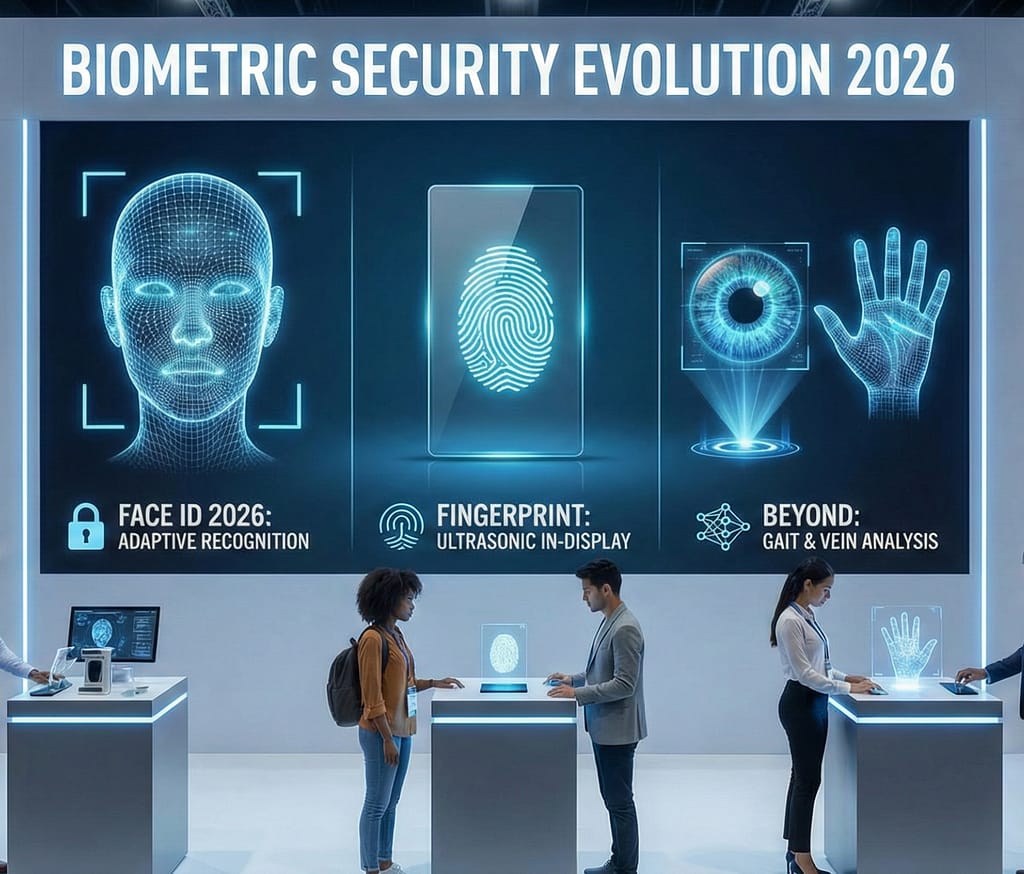

Biometric security has rapidly evolved from a futuristic concept into a core pillar of modern digital protection. In 2026, biometric security technology is no longer limited to unlocking smartphones — it protects bank accounts, secures workplaces, verifies identities at airports, and safeguards global data systems.
Biometric Security Technology 2026 represents a major transformation in how identity is verified in both digital and physical environments. With the expansion of artificial intelligence, machine learning, and advanced sensors, biometric systems have become faster, smarter, and more reliable than ever before.
This in-depth analysis explores the evolution of biometric systems, the dominance of Face ID and fingerprint scanning, emerging technologies beyond traditional methods, security concerns, privacy implications, and the future of identity verification.
What Is Biometric Security Technology?
Biometric security refers to authentication systems that verify identity using unique biological or behavioral characteristics.
Common biometric identifiers include:
- Facial recognition
- Fingerprint scanning
- Iris scanning
- Voice recognition
- Palm vein recognition
- Behavioral biometrics
Unlike passwords or PIN codes, biometric data is unique to each individual, making it more difficult to replicate or steal.
In 2026, biometrics are integrated into smartphones, financial systems, border control, healthcare databases, and enterprise security frameworks.
Evolution of Biometric Authentication
Biometric technology has evolved significantly over the past decade.
Early Phase: Basic Fingerprint Scanners
Initial fingerprint systems were slow and less accurate. They relied on surface-level pattern recognition and were vulnerable to spoofing.
Advanced Phase: 3D Face Recognition
Modern facial recognition systems use depth sensors and infrared mapping to create detailed facial models. These systems analyze thousands of data points within milliseconds.
AI Integration Era
In 2026, AI enhances biometric accuracy by:
- Improving pattern recognition
- Detecting fake or spoof attempts
- Learning behavioral patterns
- Adapting to changes in appearance
This integration has made biometric systems significantly more reliable.
Face ID Technology in 2026
Facial recognition has become one of the most widely adopted biometric systems.
Modern Face ID systems use:
- Infrared cameras
- 3D depth mapping
- Machine learning algorithms
- Real-time facial geometry analysis
Unlike older 2D face unlock methods, 3D systems create a mathematical model of a user’s face.
Improvements in 2026
Biometric Security Technology 2026 has improved Face ID in several ways:
- Faster recognition speed
- Better low-light performance
- Improved mask detection
- Enhanced anti-spoofing protection
- Reduced false positives
Face recognition is now widely used in:
- Smartphones
- Banking authentication
- Airport identity checks
- Secure facility access
Fingerprint Scanning Technology Advancements
Fingerprint recognition remains one of the most trusted biometric methods.
In 2026, fingerprint technology includes:
- Ultrasonic fingerprint scanners
- In-display optical sensors
- 3D fingerprint mapping
- Multi-layer skin detection
Ultrasonic scanners create detailed 3D images of fingerprints, making them more secure than older optical systems.
Fingerprint authentication is popular due to:
- Speed
- Reliability
- User familiarity
- Cost-effectiveness
Even with facial recognition growth, fingerprint security remains dominant in many industries.
Iris and Retina Scanning
Iris scanning analyzes the unique patterns in the colored part of the eye. Retina scanning examines blood vessel patterns at the back of the eye.
These methods are highly accurate but require specialized hardware.
In 2026, iris recognition is primarily used in:
- High-security government facilities
- Border control systems
- Military environments
Though not as common in consumer devices, they provide strong authentication for critical systems.
Voice Recognition and Behavioral Biometrics
Voice recognition is increasingly used in:
- Banking customer support
- Smart assistants
- Secure communication platforms
Behavioral biometrics analyze patterns such as:
- Typing rhythm
- Mouse movement
- Touchscreen interaction
- Gait recognition
Unlike static biometrics, behavioral systems continuously monitor user activity to detect suspicious behavior.
This adds an additional layer of security.
Biometric Security in Smartphones
Smartphones are the primary platform for biometric adoption.
In 2026, most flagship devices support:
- 3D facial recognition
- Ultrasonic fingerprint scanning
- Secure hardware encryption
- AI-powered threat detection
Biometric authentication protects:
- Digital payments
- App access
- Secure folders
- Online banking
Mobile biometric systems are becoming more secure with hardware-based encryption chips.
Biometric Security in Financial Institutions
Banks rely heavily on biometric systems to reduce fraud.
Applications include:
- Biometric ATM access
- Voice authentication in customer service
- Face recognition for account login
- Behavioral monitoring for fraud detection
Financial fraud detection systems now use AI to analyze transaction patterns along with biometric data.
Biometric Security in Airports and Border Control
Airports worldwide are adopting biometric systems for:
- Facial recognition boarding
- Passport verification
- Automated immigration gates
These systems reduce waiting times while enhancing security.
Biometric border control improves efficiency and reduces identity fraud.
Enterprise and Workplace Security
Companies use biometric systems to:
- Control building access
- Secure sensitive data centers
- Monitor employee attendance
- Protect confidential systems
Multi-factor biometric authentication is becoming standard in enterprise environments.
Privacy Concerns and Ethical Issues
Despite advantages, biometric technology raises privacy concerns.
Key issues include:
- Data storage risks
- Unauthorized data sharing
- Mass surveillance concerns
- Data breaches involving biometric information
Unlike passwords, biometric data cannot be changed easily once compromised.
In 2026, governments are implementing stricter data protection regulations for biometric storage and usage.
Security Risks and Spoofing Attempts
Cybercriminals attempt to bypass biometric systems using:
- Deepfake technology
- High-resolution face images
- Synthetic fingerprints
- AI voice cloning
To counter this, modern biometric systems include:
- Liveness detection
- Multi-angle scanning
- AI anomaly detection
- Hardware-level encryption
Continuous innovation is required to stay ahead of attackers.
Multi-Modal Biometric Systems
Biometric Security Technology 2026 is moving toward multi-modal authentication.
This combines multiple identifiers, such as:
- Face + fingerprint
- Voice + behavioral pattern
- Iris + facial recognition
Multi-layered authentication increases security significantly.
AI and the Future of Biometric Security
Artificial intelligence plays a central role in biometric accuracy.
AI improves:
- Pattern recognition
- False rejection rate reduction
- Fraud detection
- Adaptive authentication
Future systems may include continuous authentication, where devices verify identity in the background without user interaction.
Biometric Security and Digital Identity
Governments are exploring biometric-based digital identity systems.
These systems could simplify:
- Online government services
- Healthcare access
- Financial inclusion
- Digital voting systems
Secure biometric identity frameworks may become the foundation of digital citizenship.
Economic Impact of Biometric Technology
The global biometric security market continues to grow rapidly.
Industries investing heavily in biometric solutions include:
- Banking
- Healthcare
- Government
- Retail
- Telecommunications
Demand for biometric hardware, AI integration, and cybersecurity specialists is increasing.
Future Trends Beyond 2026
Future biometric advancements may include:
- DNA-based authentication
- Brainwave recognition
- Advanced palm vein scanning
- Invisible continuous authentication
As digital systems become more advanced, identity verification will become smarter and less intrusive.
Conclusion
Biometric Security Technology 2026 has transformed how individuals and organizations protect sensitive data. From advanced Face ID systems and ultrasonic fingerprint scanners to behavioral biometrics and AI-powered authentication, identity verification has entered a new era.
While privacy concerns and security risks remain, innovation continues to strengthen biometric systems. The future of authentication lies in multi-modal, AI-driven, and continuous identity verification models.
As digital ecosystems expand, biometric security will play an increasingly critical role in protecting data, infrastructure, and personal identity.
For readers of Digital Technologia, understanding biometric advancements is essential in navigating the future of secure digital interaction.