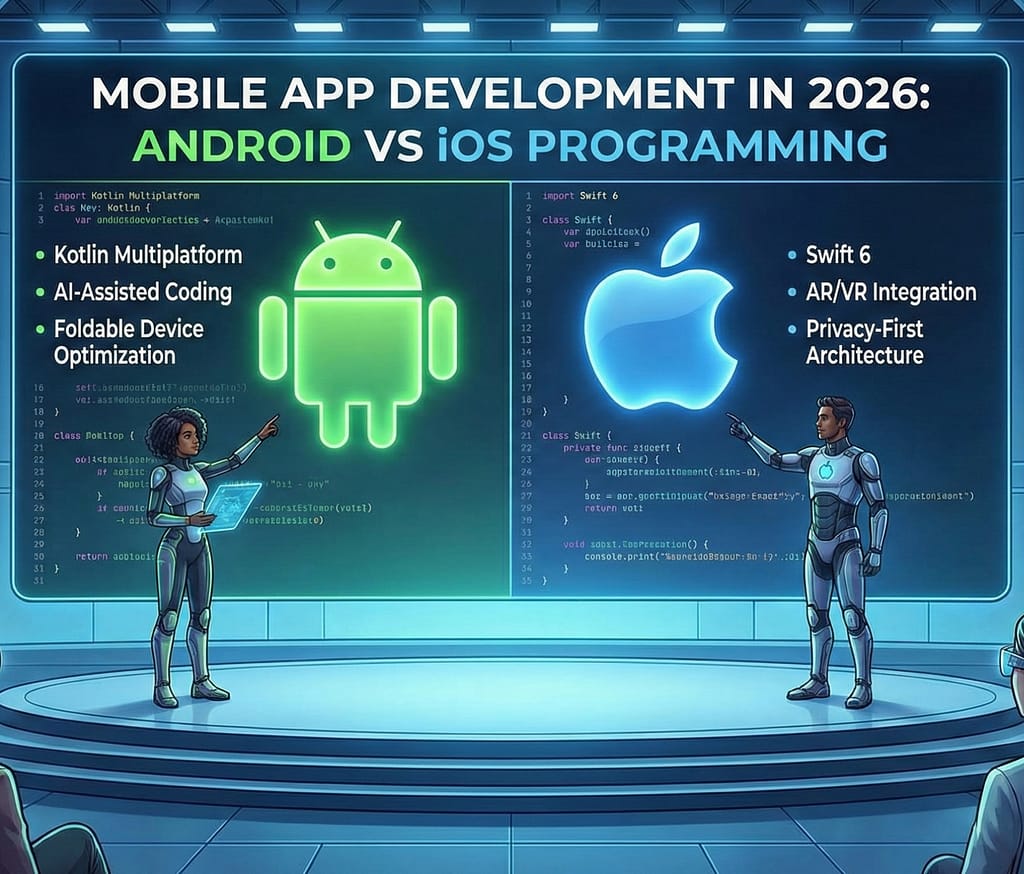

Mobile applications have become the backbone of the digital economy in 2026. From banking and e-commerce to healthcare and entertainment, mobile apps drive user engagement, business growth, and digital transformation worldwide.
With billions of smartphone users globally, businesses now prioritize mobile-first strategies. As a result, mobile app development is one of the most in-demand and future-proof skills in the technology industry.
However, aspiring developers often face a crucial question:
Should I choose Android development or iOS development?
This comprehensive guide compares Android and iOS programming in terms of tools, languages, development environment, monetization, global demand, learning curve, and long-term career scope.
Understanding the Mobile Ecosystem in 2026
Two major platforms dominate mobile development:
- Android
- iOS
Android holds the largest global market share, especially in Asia, Africa, and developing markets. iOS dominates premium markets like North America, Europe, and parts of East Asia.
Both ecosystems are mature, powerful, and constantly evolving.
Android Development in Detail
Android is an open-source platform supported by Google and used by multiple device manufacturers such as Samsung, Xiaomi, OnePlus, and others.
Core Programming Languages
Modern Android apps are developed using:
- Kotlin
- Java
Kotlin is now the preferred language because it:
- Is more concise
- Reduces boilerplate code
- Improves null safety
- Integrates fully with existing Java projects
Android Development Tools
The official development environment is Android Studio.
It provides:
- Code editor
- Visual layout designer
- Emulator
- Debugging tools
- Performance analyzer
Publishing apps happens through Google Play Console.
Android Development Strengths
| Feature | Advantage |
|---|---|
| Massive User Base | Global reach |
| Device Variety | Multiple screen sizes |
| Open Ecosystem | More flexibility |
| Lower Publishing Fee | Easier entry |
Android development is ideal for startups targeting mass markets.
Android Development Challenges
- Device fragmentation
- Testing on multiple hardware variations
- Performance optimization across low-end devices
Developers must consider wide hardware diversity.
iOS Development in Detail
iOS is Apple’s proprietary operating system used on iPhone and iPad devices.
It operates in a controlled and tightly integrated ecosystem.
Core Programming Language
iOS development primarily uses:
- Swift
Swift is modern, safe, and designed specifically for Apple platforms.
iOS Development Tools
The official development environment is Xcode.
Xcode includes:
- Code editor
- Interface builder
- iOS simulator
- Debugging tools
- Performance profiling
Apps are published through Apple’s App Store using App Store Connect.
iOS Development Strengths
| Feature | Advantage |
|---|---|
| Premium User Base | Higher spending |
| Consistent Devices | Easier optimization |
| Strong Security | Controlled environment |
| Better Monetization | Higher revenue per user |
iOS is ideal for businesses targeting premium markets.
iOS Development Challenges
- Higher developer program fee
- Strict App Store review guidelines
- Limited device flexibility
Publishing requires meeting Apple’s quality standards.
Android vs iOS: Technical Deep Comparison
| Aspect | Android | iOS |
|---|---|---|
| Market Share | Larger globally | Smaller but premium |
| Programming Language | Kotlin / Java | Swift |
| IDE | Android Studio | Xcode |
| Device Diversity | High | Limited |
| Customization | High | Moderate |
| Security | Strong | Very Strong |
| Revenue Potential | Moderate | High |
Both platforms are technically powerful but serve slightly different strategic goals.
Cross-Platform Development in 2026
Instead of choosing one platform, many developers now use cross-platform frameworks.
Popular tools include:
- Flutter
- React Native
These allow developers to write one codebase and deploy apps for both Android and iOS.
Why Cross-Platform Is Growing
| Benefit | Explanation |
|---|---|
| Faster Development | Single codebase |
| Lower Cost | Reduced team size |
| Easier Maintenance | Unified updates |
| Startup Friendly | Faster MVP launch |
Cross-platform development is highly attractive for startups and small teams.
Career Scope in 2026
Mobile development continues to show strong hiring trends.
Android Developer Career
- Strong demand in emerging markets
- Large freelance ecosystem
- Startup opportunities
- Remote job flexibility
iOS Developer Career
- High-paying jobs in premium markets
- Strong enterprise demand
- High-value product development
- International opportunities
Salary and Demand Outlook
While exact salaries depend on country and experience level, trends show:
- iOS developers often earn slightly higher in developed markets
- Android developers have more job openings globally
- Cross-platform developers are increasingly valued
Companies prefer developers who understand mobile architecture deeply rather than just basic coding.
Monetization and Business Model Comparison
| Monetization Model | Android | iOS |
|---|---|---|
| In-App Purchases | Strong | Very Strong |
| Ad Revenue | Common | Less dominant |
| Subscription Apps | Growing | Very Profitable |
| Enterprise Apps | Moderate | Strong |
iOS users typically spend more per app.
Learning Curve Comparison
| Factor | Android | iOS |
|---|---|---|
| Beginner Friendliness | Moderate | Moderate |
| Documentation | Extensive | Excellent |
| Community Support | Massive | Strong |
| Hardware Requirement | Flexible | Requires Mac |
iOS development requires a Mac system, which can be a barrier for beginners.
Industry Use Cases
Mobile development serves multiple industries:
| Industry | Use Case |
|---|---|
| Banking | Secure financial apps |
| Healthcare | Patient monitoring apps |
| E-commerce | Shopping platforms |
| Education | Learning apps |
| Travel | Booking systems |
| Entertainment | Streaming platforms |
Mobile apps are central to digital transformation strategies.
Future Trends in Mobile App Development
Mobile development in 2026 and beyond includes:
- AI-powered personalization
- Augmented reality integration
- Voice interface support
- IoT connectivity
- Advanced security protocols
Apps are becoming smarter and more connected.
Which Platform Should You Choose?
Choose Android if:
- You want mass market reach
- You prefer flexible ecosystems
- You target developing regions
Choose iOS if:
- You focus on premium users
- You want higher revenue potential
- You prefer controlled ecosystem
Choose cross-platform if:
- You want to target both markets
- You are building a startup
- You want faster deployment
Final Conclusion
Mobile App Development in 2026 remains one of the most dynamic and rewarding technology fields. Android provides broader global reach, while iOS offers premium monetization and strong ecosystem integration.
Both platforms offer excellent career opportunities, and the rise of cross-platform frameworks makes mobile development more accessible than ever.
Choosing between Android and iOS depends on your career goals, target audience, budget, and long-term strategy. Regardless of the path chosen, mobile development continues to evolve with innovation and high demand.
For aspiring developers, learning mobile development is a future-proof investment in a rapidly growing digital industry.