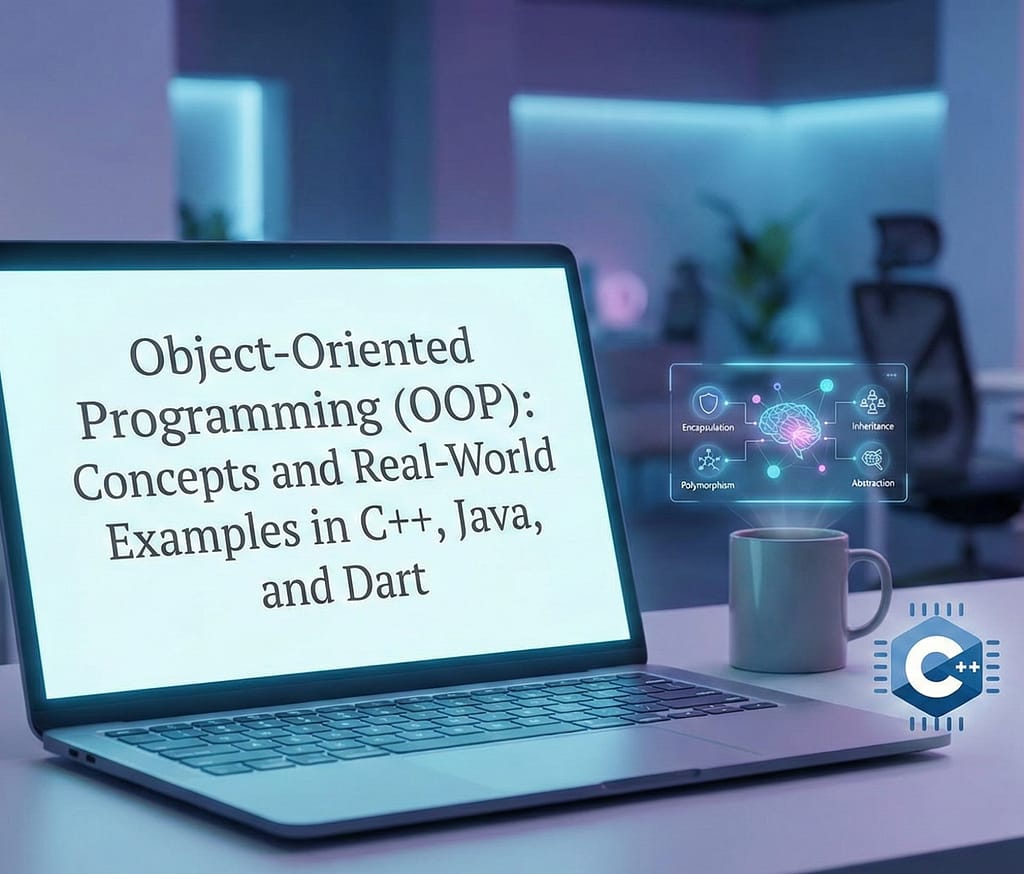

Object-Oriented Programming (OOP) is one of the most widely used programming paradigms in modern software development. In 2026, major programming languages such as C++, Java, and Dart rely heavily on OOP principles to build scalable, maintainable, and structured applications.
Instead of focusing on individual instructions, OOP focuses on “objects” — real-world entities that combine data and behavior. This approach makes complex systems easier to design, understand, and maintain.
The four main pillars of Object-Oriented Programming are:
- Encapsulation
- Inheritance
- Polymorphism
- Abstraction
Let’s explore each concept clearly, with real-world understanding — not classroom code — so your readers truly understand how OOP works.
What Is Object-Oriented Programming?
Object-Oriented Programming is a way of structuring software around “objects” instead of actions.
An object represents something from the real world. For example:
- A Car
- A User
- A Bank Account
- A Product
Each object contains:
- Data (attributes or properties)
- Behavior (functions or actions it can perform)
Languages such as C++, Java, and Dart use OOP to structure software applications in a logical way.
OOP helps developers manage complexity when building large systems like mobile apps, websites, banking software, and enterprise tools.
1. Encapsulation: Protecting Data
Encapsulation means wrapping data and methods together into a single unit and restricting direct access to internal details.
Think of a bank account.
You cannot directly change your account balance. You must perform actions like:
- Deposit money
- Withdraw money
- Check balance
The internal calculation logic remains hidden.
This is encapsulation.
It ensures:
- Data protection
- Controlled access
- Security
- Clean structure
In languages like C++, Java, and Dart, encapsulation is implemented by restricting access to certain parts of a class. This prevents accidental misuse of important data.
Why Encapsulation Matters in Real Applications
In real-world systems such as:
- Banking software
- E-commerce platforms
- Healthcare systems
Sensitive data must be protected.
Encapsulation prevents unauthorized access and ensures that data changes only through approved methods.
2. Inheritance: Reusing Existing Logic
Inheritance allows one class to reuse properties and behavior from another class.
Think of a general category called “Vehicle.”
From Vehicle, we can create:
- Car
- Bike
- Truck
All vehicles share common features like speed and engine status. Instead of rewriting the same logic for every type, inheritance allows us to reuse it.
This saves development time and avoids duplication.
Why Inheritance Is Powerful
| Advantage | Explanation |
|---|---|
| Code Reusability | Avoid rewriting common logic |
| Organized Structure | Clear parent-child relationships |
| Faster Development | Build on existing components |
| Scalability | Easy to expand system |
In large enterprise systems, inheritance helps structure code hierarchically and logically.
All major OOP languages — C++, Java, and Dart — support inheritance to promote modular design.
3. Polymorphism: One Interface, Multiple Behavior
Polymorphism means “many forms.”
It allows a single function or method name to behave differently depending on the object.
Imagine a Shape system.
You may have:
- Circle
- Rectangle
- Triangle
Each shape calculates area differently.
Even though the method name may be “calculateArea,” each object performs its own version of the logic.
That is polymorphism.
Real-World Importance of Polymorphism
Polymorphism allows:
- Flexible system design
- Easy feature expansion
- Cleaner code structure
- Reduced conditional logic
Instead of writing complex “if-else” statements, developers rely on polymorphism to handle variations.
In modern software development, polymorphism is essential for:
- Plugin systems
- Payment gateways
- UI components
- Game characters
All these systems use common interfaces but different implementations.
4. Abstraction: Hiding Complexity
Abstraction hides internal implementation details and shows only essential features.
Consider driving a car.
You use:
- Steering wheel
- Brake pedal
- Accelerator
You do not need to understand how the engine works internally.
The complex mechanics are hidden.
This is abstraction.
In programming, abstraction hides complicated logic behind simple interfaces.
Why Abstraction Is Critical
| Benefit | Explanation |
|---|---|
| Simplifies Development | Focus only on what is needed |
| Improves Security | Hide internal logic |
| Enhances Maintainability | Change internal logic without affecting users |
| Reduces Complexity | Cleaner architecture |
In large systems like operating systems, mobile apps, or cloud platforms, abstraction allows developers to build layers without exposing internal details.
OOP in C++, Java, and Dart
Although C++, Java, and Dart are different languages, they all follow OOP principles.
C++
C++ is powerful and supports both procedural and object-oriented programming. It is widely used in:
- Game development
- System software
- High-performance applications
C++ offers deep control over memory and performance while supporting full OOP structure.
Java
Java is strongly object-oriented and is widely used in:
- Enterprise applications
- Android development
- Banking systems
Java enforces structured OOP design, making it ideal for large-scale enterprise software.
Dart
Dart is modern and primarily used with Flutter for mobile app development.
It supports clean OOP architecture and is optimized for:
- Cross-platform apps
- UI-focused development
- Modern app ecosystems
Why OOP Dominates Modern Programming
Object-Oriented Programming dominates because modern applications are complex.
Consider:
- E-commerce platforms
- Social media apps
- Online banking systems
- AI-powered applications
These systems contain:
- Thousands of interacting components
- Multiple data layers
- Security rules
- User roles
OOP allows developers to organize these systems logically.
Real-World Applications of OOP
| Industry | Example Use Case |
|---|---|
| Banking | Account & transaction systems |
| Healthcare | Patient record management |
| E-commerce | Product and order management |
| Gaming | Player and enemy objects |
| Mobile Apps | UI components and data models |
OOP makes these systems manageable and scalable.
Advantages of Object-Oriented Programming
- Better code organization
- Improved maintainability
- High reusability
- Increased security
- Easier debugging
- Scalable architecture
For teams working on large projects, OOP is essential.
Limitations of OOP
While powerful, OOP also has some challenges:
- Can become complex if poorly designed
- Requires proper planning
- Slightly higher memory usage compared to procedural programming
However, for most modern applications, benefits outweigh drawbacks.
Future of OOP in 2026 and Beyond
As software systems grow more advanced — especially in AI, cloud computing, and mobile ecosystems — OOP remains foundational.
Even modern frameworks and platforms rely heavily on object-oriented design patterns.
OOP is not outdated. It continues evolving alongside modern programming practices.
Final Conclusion
Object-Oriented Programming is a foundational concept that shapes modern software development. The four pillars — Encapsulation, Inheritance, Polymorphism, and Abstraction — provide a structured approach to building scalable and maintainable systems.
Languages like C++, Java, and Dart strongly implement OOP principles and power applications across industries, from enterprise software to mobile apps and AI systems.
Understanding OOP is essential for every programmer who wants to build professional, real-world software systems in 2026 and beyond.