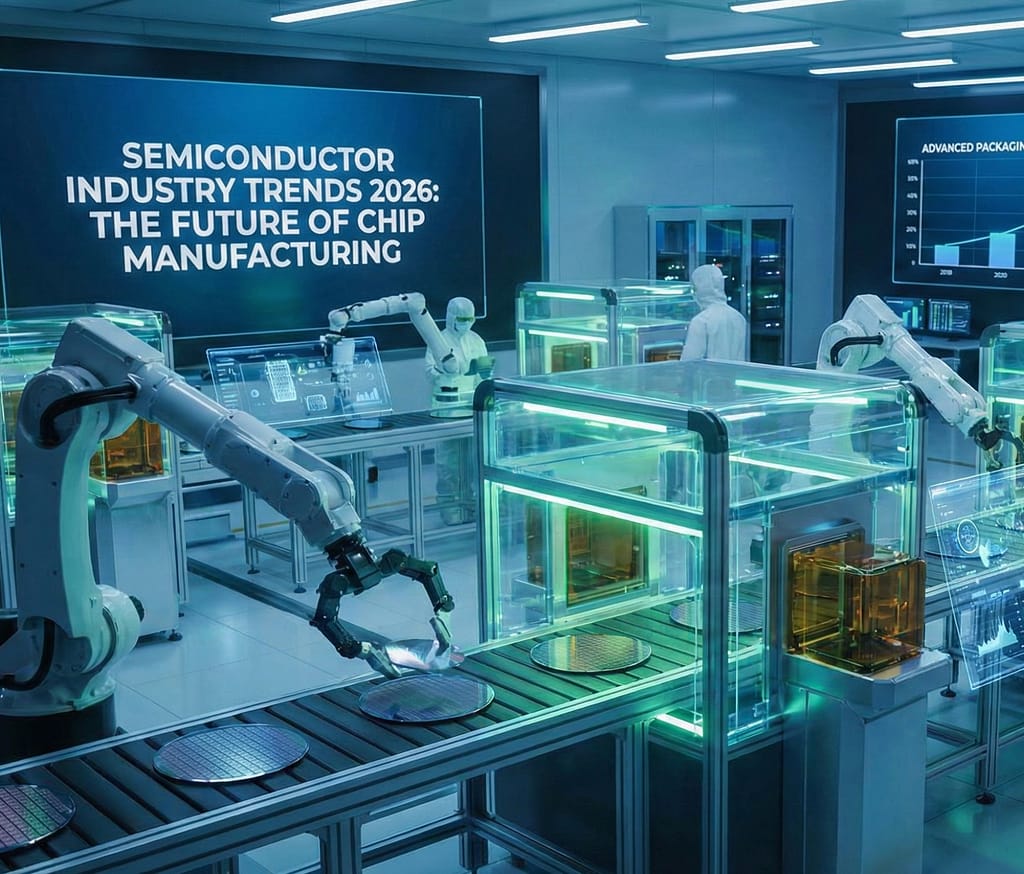

The semiconductor industry is the backbone of the modern digital world. Every smartphone, laptop, data center, electric vehicle, robotics system, and artificial intelligence platform depends on advanced chips. In 2026, semiconductor innovation is accelerating at an unprecedented pace, driven by artificial intelligence, geopolitical shifts, supply chain restructuring, and next-generation manufacturing technologies.
Semiconductor Industry Trends 2026 represent a turning point in global technology infrastructure. As demand for computing power increases across AI, cloud computing, autonomous vehicles, 6G networks, and robotics, chip manufacturing is undergoing rapid transformation.
This in-depth analysis explores the state of the semiconductor industry in 2026, emerging manufacturing technologies, geopolitical impacts, AI-driven chip design, advanced packaging, sustainability efforts, and what the future holds for global chip production.
Why the Semiconductor Industry Is So Important
Semiconductors power nearly every modern technology system:
- Smartphones and tablets
- Data centers and cloud infrastructure
- Electric vehicles and autonomous systems
- AI processors and GPUs
- 5G and emerging 6G networks
- Robotics and automation
Without advanced chip manufacturing, digital transformation would stall. The semiconductor industry is not just a technology sector — it is critical infrastructure for the global economy.
The Global Semiconductor Landscape in 2026
The semiconductor industry is highly concentrated but globally interconnected.
Major players include:
- TSMC
- Samsung Electronics
- Intel
- NVIDIA
- ASML
Each plays a distinct role:
- Foundries manufacture chips
- Designers create chip architectures
- Equipment manufacturers build lithography systems
- AI companies drive high-performance demand
In 2026, global semiconductor production remains strategically sensitive due to geopolitical tensions and supply chain vulnerabilities.
Advanced Node Manufacturing: 3nm and Beyond
One of the biggest semiconductor industry trends in 2026 is the push toward smaller process nodes.
Advanced nodes such as:
- 5nm
- 3nm
- Early 2nm development
allow for:
- Higher transistor density
- Lower power consumption
- Faster performance
Shrinking transistor size improves computational efficiency. However, manufacturing at these scales requires extreme precision and advanced lithography tools.
The cost of building advanced fabrication plants (fabs) has increased significantly, reaching tens of billions of dollars.
EUV Lithography and Manufacturing Precision
Extreme Ultraviolet (EUV) lithography has become essential for advanced chip production.
EUV machines enable:
- More precise transistor patterning
- Smaller chip features
- Improved performance scaling
EUV systems are extremely complex and expensive, limiting access to a few global manufacturers.
In 2026, advanced lithography remains a strategic technological advantage.
AI Driving Semiconductor Demand
Artificial intelligence is one of the biggest drivers of semiconductor growth.
AI workloads require:
- High-performance GPUs
- Specialized AI accelerators
- Advanced memory systems
- Efficient data transfer architectures
Training large AI models demands massive computational power, increasing demand for high-end chips.
AI-driven data centers are expanding rapidly, creating sustained semiconductor growth.
Chiplet Architecture and Advanced Packaging
Traditional monolithic chip designs are becoming less efficient at smaller nodes.
One major Semiconductor Industry Trend 2026 is chiplet architecture.
Chiplets allow:
- Multiple smaller chip components
- Improved yield rates
- Flexible customization
- Reduced manufacturing costs
Advanced packaging techniques such as:
- 3D stacking
- Heterogeneous integration
- System-in-package designs
are redefining how chips are assembled.
This approach improves performance without relying solely on smaller nodes.
Semiconductor Industry and Geopolitics
The semiconductor industry has become central to global geopolitics.
Governments are investing heavily in domestic chip manufacturing to reduce reliance on foreign suppliers.
Key developments include:
- National semiconductor funding programs
- Incentives for domestic fab construction
- Export controls on advanced technologies
Semiconductors are now considered strategic assets in global economic competition.
Supply Chain Diversification
The COVID-era supply chain disruptions highlighted semiconductor vulnerabilities.
In 2026, companies are focusing on:
- Multi-region production
- Localized manufacturing
- Inventory resilience strategies
- Long-term supplier agreements
Diversification reduces risk and improves global chip stability.
Automotive Semiconductor Demand
The automotive industry has become a major semiconductor consumer.
Modern vehicles require chips for:
- Advanced driver-assistance systems
- Electric power management
- Infotainment systems
- Autonomous driving
Electric vehicles and self-driving systems significantly increase chip demand.
Automotive-grade semiconductors must meet strict reliability standards.
Memory and Storage Innovations
Semiconductor Industry Trends 2026 also include advancements in memory technology.
Key areas of innovation:
- High-bandwidth memory (HBM)
- Next-generation DRAM
- NAND flash improvements
- Persistent memory research
AI and data center workloads require high-speed memory solutions.
Memory scaling is becoming as important as processor scaling.
Semiconductor and Quantum Computing
While still emerging, quantum computing research influences semiconductor innovation.
Although quantum chips differ from traditional silicon chips, manufacturing expertise overlaps in:
- Nanofabrication
- Precision engineering
- Cryogenic hardware development
Long-term semiconductor strategies include quantum readiness.
Sustainability in Chip Manufacturing
Semiconductor production consumes significant energy and water.
In 2026, sustainability initiatives include:
- Renewable energy usage in fabs
- Water recycling systems
- Carbon footprint reduction
- Efficient chemical processing
Sustainable semiconductor manufacturing is becoming a competitive advantage.
Environmental regulations are influencing industry standards.
Workforce and Talent Shortage
Advanced semiconductor manufacturing requires highly specialized engineers.
Challenges include:
- Skilled labor shortages
- Advanced engineering education demand
- Talent competition between nations
Investment in STEM education is critical for future industry growth.
AI-Assisted Chip Design
Artificial intelligence is not only driving chip demand but also improving chip design.
AI-assisted design tools enable:
- Faster circuit optimization
- Power efficiency improvements
- Automated layout generation
Design automation reduces development time and cost.
AI-designed chips may outperform human-optimized layouts in certain scenarios.
Edge Computing and Specialized Chips
Edge computing requires localized data processing.
This drives demand for:
- Low-power processors
- AI edge accelerators
- IoT-specific chipsets
Semiconductor companies are developing specialized chips tailored for specific applications.
Customization is becoming a key competitive strategy.
The Rise of Custom Silicon
Large technology companies increasingly design their own chips.
Custom silicon offers:
- Optimized performance
- Improved energy efficiency
- Vertical integration advantages
This reduces dependence on third-party chip suppliers.
Custom chip design is reshaping industry dynamics.
Semiconductor Investment and Capital Expenditure
Semiconductor manufacturing is capital-intensive.
Building advanced fabs requires:
- Billions of dollars
- Long-term planning
- Government incentives
- Advanced supply chains
Capital investment remains at historic highs in 2026.
Cybersecurity in Semiconductor Manufacturing
Chip production facilities rely heavily on digital systems.
Cybersecurity is critical to protect:
- Intellectual property
- Manufacturing processes
- Supply chain integrity
Advanced security frameworks protect semiconductor infrastructure.
Long-Term Outlook: Beyond 2026
Looking beyond 2026, key semiconductor trends may include:
- 2nm and sub-2nm process nodes
- Advanced 3D chip stacking
- Photonic computing integration
- Neuromorphic chips
- Quantum-assisted processors
Innovation will continue but at increasing complexity and cost.
Are We Reaching the Limits of Moore’s Law?
Moore’s Law predicted transistor density doubling approximately every two years.
In 2026:
- Physical scaling is slowing
- Costs are rising
- Alternative architectures are emerging
Instead of pure scaling, innovation now focuses on:
- Architecture optimization
- AI acceleration
- Packaging improvements
The industry is adapting beyond traditional scaling models.
Economic Impact of Semiconductor Industry Trends 2026
The semiconductor sector drives:
- Global technology growth
- Digital infrastructure expansion
- National security strategies
- Employment opportunities
Chips are foundational to economic competitiveness.
Countries investing in semiconductor leadership gain strategic advantages.
Final Conclusion
Semiconductor Industry Trends 2026 reveal a highly dynamic and strategically critical sector. Advanced node manufacturing, AI-driven chip demand, chiplet architecture, sustainability initiatives, and geopolitical shifts are reshaping the global semiconductor ecosystem.
While scaling challenges and geopolitical tensions remain, innovation continues across manufacturing techniques, design automation, and advanced packaging.
Semiconductors are no longer just electronic components — they are the foundation of artificial intelligence, robotics, electric vehicles, smart cities, cloud computing, and next-generation connectivity.
For readers of Digital Technologia, understanding semiconductor trends means understanding the core engine powering the modern digital world.