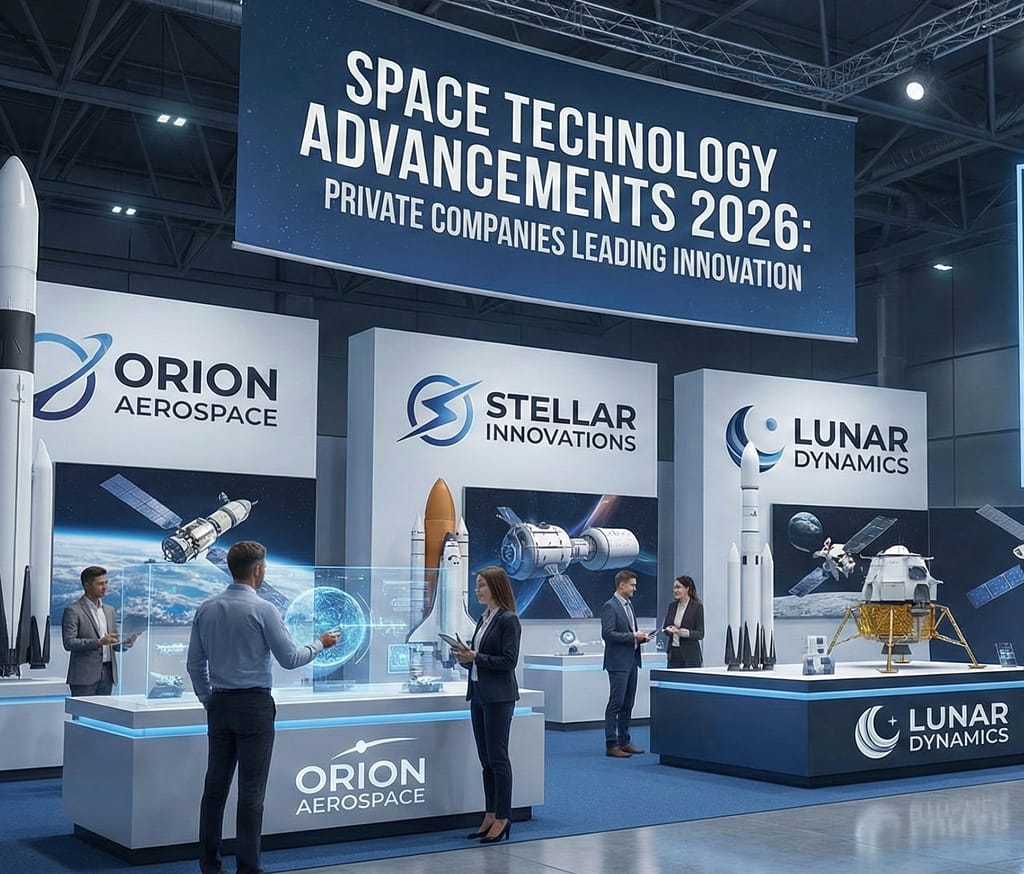

The global space industry is undergoing one of the most transformative periods in history. Once dominated entirely by government space agencies, the space sector in 2026 is increasingly driven by private companies pushing the boundaries of innovation. Space Technology Advancements 2026 are no longer limited to satellite launches — they now include reusable rockets, commercial space stations, lunar missions, satellite internet constellations, and even early discussions of interplanetary travel.
Private companies are reshaping how space missions are designed, funded, and executed. By reducing costs, accelerating innovation, and introducing competitive efficiency, these companies are redefining the global space economy.
This in-depth article explores how private enterprises are leading space innovation in 2026, the technologies driving growth, key industry players, economic impact, challenges, and what the future of commercial space exploration may look like.
The Shift from Government to Commercial Space
Historically, space exploration was controlled by national agencies such as:
- NASA
- European Space Agency
- ISRO
- Roscosmos
These agencies were responsible for major milestones like moon landings, planetary exploration, and satellite launches.
However, in the past decade, private companies have entered the space industry with innovative business models and aggressive development strategies. Governments now often collaborate with private companies rather than operating independently.
In 2026, public-private partnerships are a major driver of space technology growth.
Reusable Rocket Technology
One of the most important space technology advancements of recent years is reusable rocket systems.
Private companies have developed rockets that can:
- Launch payloads into orbit
- Return safely to Earth
- Be refurbished and reused
This dramatically reduces launch costs compared to traditional single-use rockets.
Reusable rocket technology has:
- Increased launch frequency
- Lowered entry barriers for smaller companies
- Expanded satellite deployment
Cost reduction has been a key factor in accelerating space commercialization.
Satellite Internet Constellations
In 2026, satellite constellations are transforming global internet access.
Private companies are launching thousands of small satellites into low Earth orbit to provide:
- High-speed broadband
- Connectivity in remote areas
- Emergency communication services
- Support for maritime and aviation industries
Satellite internet systems reduce reliance on ground infrastructure and expand global digital access.
This innovation has major implications for developing regions and disaster response operations.
Commercial Space Stations
As international space agencies plan long-term missions, private companies are working on commercial space stations.
These stations may serve purposes such as:
- Scientific research
- Space tourism
- Manufacturing in microgravity
- Private astronaut missions
The commercialization of orbital platforms represents a major shift from government-exclusive research environments.
Private space stations could become hubs for research institutions and corporations.
Lunar Missions and Moon Exploration
The Moon has regained global interest in 2026.
Private companies are collaborating with space agencies to:
- Develop lunar landers
- Deliver cargo to the Moon
- Support future lunar bases
- Test deep-space technologies
The Moon is viewed as a strategic location for scientific research and future deep-space missions.
Private sector involvement accelerates mission timelines and introduces innovative engineering approaches.
Mars Exploration and Long-Term Goals
Although human missions to Mars remain in development, private companies are investing heavily in long-term interplanetary goals.
Mars exploration initiatives include:
- Spacecraft development
- Advanced propulsion systems
- Habitat testing
- Closed-loop life support systems
While still in early stages, private companies are leading research into sustainable deep-space travel.
Advancements in Satellite Technology
Modern satellites are becoming smaller, smarter, and more efficient.
In 2026, satellite technology includes:
- Miniaturized components
- AI-powered onboard processing
- High-resolution Earth observation sensors
- Advanced climate monitoring systems
Private satellite companies provide services for:
- Agriculture monitoring
- Weather prediction
- Urban planning
- Environmental research
Satellite data is now a critical part of global digital infrastructure.
AI and Automation in Space Missions
Artificial intelligence plays a growing role in space operations.
AI systems assist with:
- Autonomous navigation
- Fault detection
- Data analysis
- Space debris tracking
Automation reduces the need for constant human oversight and improves mission safety.
Space Tourism Expansion
Space tourism has evolved from concept to early-stage reality.
Private companies are offering:
- Suborbital space experiences
- Orbital tourism flights
- Future plans for lunar tourism
Although currently expensive, space tourism represents a growing commercial sector.
As technology advances and costs decrease, accessibility may expand.
Space Debris Management
With increasing satellite launches, space debris has become a serious concern.
Private companies are developing:
- Debris tracking systems
- Satellite removal technologies
- Collision avoidance software
Maintaining safe orbital environments is essential for long-term space sustainability.
Economic Impact of Private Space Companies
The commercial space sector contributes significantly to the global economy.
Space-related industries include:
- Rocket manufacturing
- Satellite production
- Data services
- Telecommunications
- Aerospace engineering
Investment in space startups has increased substantially.
The global space economy is projected to continue expanding through 2030 and beyond.
National Security and Space Innovation
Space technology also plays a role in national security.
Private companies provide:
- Secure communication satellites
- Surveillance capabilities
- Navigation systems
Governments rely on commercial partners for advanced aerospace innovation.
Challenges Facing Private Space Companies
Despite rapid growth, private space companies face several challenges:
- High development costs
- Regulatory approvals
- Technical risks
- Launch failures
- Space debris congestion
Maintaining safety and reliability is essential.
Space missions require extreme precision and engineering excellence.
Environmental Concerns
Rocket launches and satellite manufacturing have environmental impacts.
Concerns include:
- Carbon emissions from rocket launches
- Atmospheric pollution
- Space debris accumulation
Companies are researching greener propulsion systems and sustainable manufacturing methods.
International Competition and Collaboration
Space technology in 2026 reflects both competition and collaboration.
Private companies operate globally while partnering with national agencies.
International cooperation is important for:
- Space traffic management
- Research missions
- Planetary protection guidelines
Space exploration increasingly involves multinational partnerships.
Future Outlook of Space Technology Beyond 2026
Future advancements may include:
- Nuclear-powered propulsion systems
- Permanent lunar bases
- Asteroid mining initiatives
- Advanced space manufacturing
- Deep-space exploration infrastructure
Private companies are expected to remain central to these developments.
The commercialization of space may redefine global innovation landscapes.
Conclusion
Space Technology Advancements 2026 highlight a transformative shift from government-dominated exploration to private-sector leadership. Reusable rockets, satellite constellations, lunar missions, and commercial space stations demonstrate how innovation is accelerating.
Private companies are reducing costs, increasing launch frequency, and expanding access to space-based services. While challenges remain, the commercial space industry continues to grow rapidly.
The collaboration between public agencies and private enterprises is shaping a new era of exploration and economic opportunity.
For readers of Digital Technologia, understanding space innovation is essential to grasping the future of global technology and connectivity.