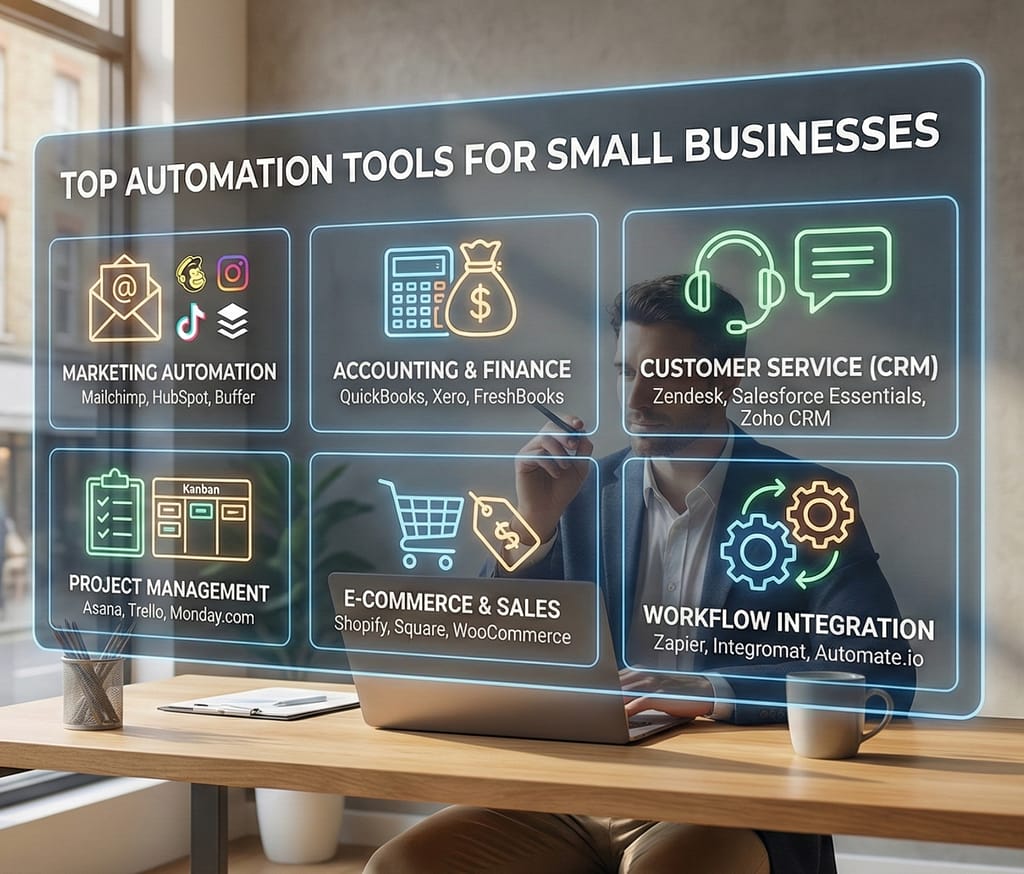

Running a small business in 2026 is very different from a decade ago. Customers expect instant replies, personalized services, smooth online experiences, and fast delivery. At the same time, small business owners often operate with limited staff and tight budgets.
This is where automation tools become powerful.
Automation tools help small businesses reduce manual work, improve efficiency, increase revenue, and scale operations without hiring large teams. From marketing and sales to accounting and customer support, automation platforms allow businesses to operate smarter.
In this guide, we explore the top automation tools for small businesses in 2026, categorized by business needs and practical use cases.
Why Automation Is Essential for Small Businesses
Small businesses typically struggle with:
- Repetitive manual tasks
- Missed customer follow-ups
- Poor data organization
- Delayed invoicing
- Inefficient marketing campaigns
Automation tools solve these problems by creating digital workflows that run automatically.
Key Benefits of Business Automation
| Benefit | Impact on Business |
|---|---|
| Time Savings | More focus on growth |
| Reduced Errors | Improved accuracy |
| Faster Customer Response | Better satisfaction |
| Lower Costs | Reduced hiring pressure |
| Scalability | Easier expansion |
Automation helps small teams compete with larger companies.
1. Marketing Automation Tools
Marketing is one of the most important areas for automation.
HubSpot
HubSpot is an all-in-one platform combining marketing and CRM tools.
What It Automates:
- Email campaigns
- Lead capture
- Customer tracking
- Follow-up reminders
Why It’s Useful:
HubSpot allows small businesses to automatically nurture leads through email sequences and track every customer interaction in one place.
| Feature | Business Benefit |
|---|---|
| Email Automation | Better engagement |
| Lead Scoring | Prioritized sales focus |
| CRM Dashboard | Organized customer data |
HubSpot offers a free plan, making it suitable for startups.
Mailchimp
Mailchimp focuses mainly on email automation.
Key Uses:
- Welcome emails
- Promotional campaigns
- Abandoned cart reminders
- Customer segmentation
Mailchimp is beginner-friendly and ideal for small e-commerce stores.
2. CRM & Sales Automation
Customer Relationship Management tools help automate sales tracking.
Zoho CRM
Zoho CRM is affordable and powerful.
What It Does:
- Tracks leads
- Automates follow-ups
- Assigns tasks to team members
- Forecasts sales
| Feature | Advantage |
|---|---|
| Pipeline Management | Clear sales tracking |
| Automated Reminders | No missed opportunities |
| Reporting | Data-driven decisions |
Perfect for growing small businesses.
Salesforce
Salesforce provides more advanced automation features, but it may be better suited for slightly larger small businesses due to pricing.
3. Workflow Automation Tools
Workflow automation connects different apps and eliminates repetitive manual work.
Zapier
Zapier connects thousands of apps together.
Example:
Customer fills a form → Automatically added to CRM → Welcome email sent → Sales team notified.
| Feature | Benefit |
|---|---|
| No-Code Setup | Easy for beginners |
| App Integrations | Flexible automation |
| Trigger Actions | Time saving |
Zapier is extremely popular among small businesses.
4. Accounting & Finance Automation
Financial management can become overwhelming without automation.
QuickBooks
QuickBooks automates:
- Invoicing
- Expense tracking
- Payroll
- Financial reports
| Feature | Business Benefit |
|---|---|
| Recurring Invoices | Consistent cash flow |
| Expense Tracking | Accurate bookkeeping |
| Financial Reports | Better planning |
It simplifies accounting for non-experts.
Xero
Xero is a cloud-based alternative offering similar automation features.
5. Customer Support Automation
Customers expect fast responses in 2026.
Zendesk
Zendesk automates:
- Ticket assignment
- Helpdesk management
- Knowledge base creation
| Feature | Result |
|---|---|
| Ticket Routing | Faster problem resolution |
| Automated Replies | 24/7 support |
| Analytics | Service improvement |
Intercom
Intercom provides AI-powered chatbots to answer customer queries instantly and qualify leads.
6. Social Media Automation
Posting manually every day wastes time.
Buffer
Buffer allows businesses to:
- Schedule posts
- Plan content calendar
- Analyze engagement
Hootsuite
Hootsuite offers more advanced analytics and multi-account management.
7. E-Commerce Automation
For online stores, automation is critical.
Shopify
Shopify automates:
- Order processing
- Payment collection
- Inventory updates
- Email marketing
It helps small online stores operate smoothly.
Comparison Table: Top Automation Tools 2026
| Tool | Category | Best For | Free Plan |
|---|---|---|---|
| HubSpot | Marketing & CRM | Startups | Yes |
| Mailchimp | Email Marketing | Small stores | Yes |
| Zoho CRM | Sales Tracking | SMB | Yes |
| Zapier | Workflow Automation | All types | Limited |
| QuickBooks | Accounting | Finance | No |
| Zendesk | Support | Service teams | No |
| Buffer | Social Media | Marketing | Yes |
| Shopify | E-commerce | Online stores | No |
How to Choose the Right Automation Tool
Before choosing, ask:
- What tasks are most time-consuming?
- What is your monthly budget?
- Do tools integrate with your current software?
- Do you need advanced reporting?
Start with one or two automation tools and expand gradually.
Common Mistakes Small Businesses Make
- Automating too many processes at once
- Choosing expensive tools unnecessarily
- Ignoring integration compatibility
- Not training staff
Automation should simplify operations, not complicate them.
Future of Small Business Automation
By 2027 and beyond, automation will become more intelligent:
- AI-powered predictive marketing
- Automated financial forecasting
- Smart sales assistants
- Fully integrated business dashboards
Automation will move from reactive to predictive systems.
Final Conclusion
The Top Automation Tools for Small Businesses in 2026 help entrepreneurs save time, reduce operational costs, and improve efficiency. Platforms like HubSpot, Zoho CRM, Zapier, QuickBooks, and Shopify allow small teams to function like large enterprises.
Automation is no longer optional — it is a competitive advantage. Small businesses that adopt automation strategically will grow faster, serve customers better, and operate more efficiently.
For your website, this topic attracts entrepreneurs, freelancers, startups, and business owners — making it excellent for SEO and monetization.